By Gloria Chou — #1 Small Business PR Expert | AI Visibility Strategist
Shopify’s president just announced that AI traffic to stores tripled in a year, and most of those sales went to smaller, more specific products. Here’s what makes AI name one brand over another, and how to become the one it names.
Table of Contents
- What did Shopify's president actually say about AI and small business?
- Why is AI now a customer acquisition channel and not just a productivity tool?
- Why are AI purchases going to niche products instead of big brands?
- How does AI decide which brands to recommend?
- What kind of press coverage actually gets cited by AI?
- How do you get your product recommended by AI without hiring an agency?
- FAQs
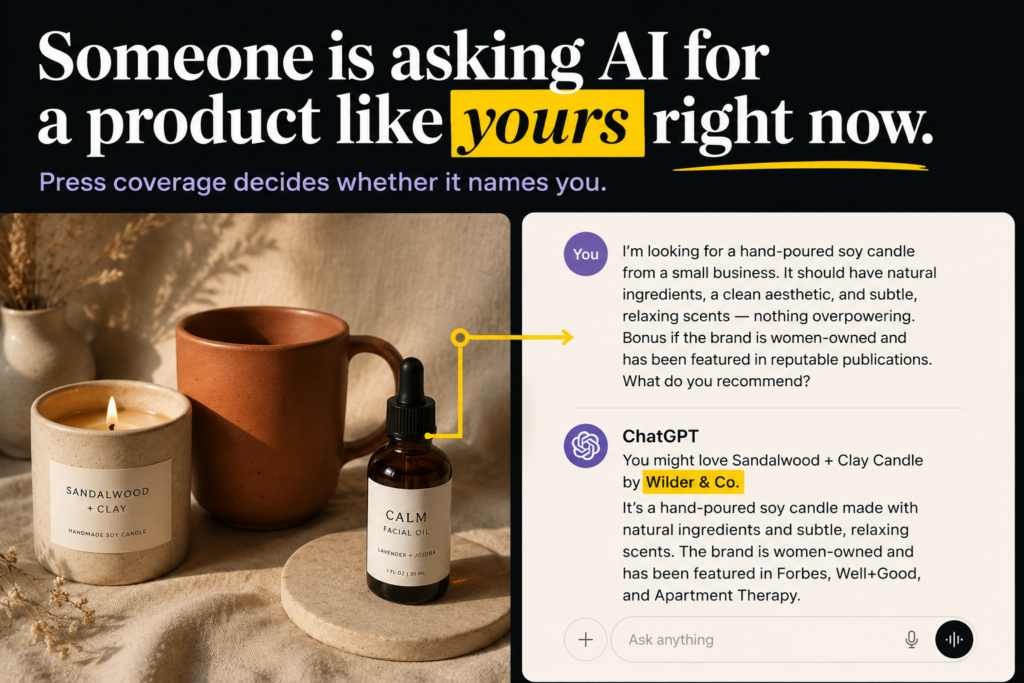
Someone is asking ChatGPT for a product like yours right now. It’s going to name a few brands, and the customer will choose from those. Everyone else in the category that doesn’t come up won’t even be considered.
What decides that isn’t your website, your ad budget, or how many years you’ve been in business. It’s consistent PR, which I’ve been saying over and over again, but now there’s new hard data to support that claim.
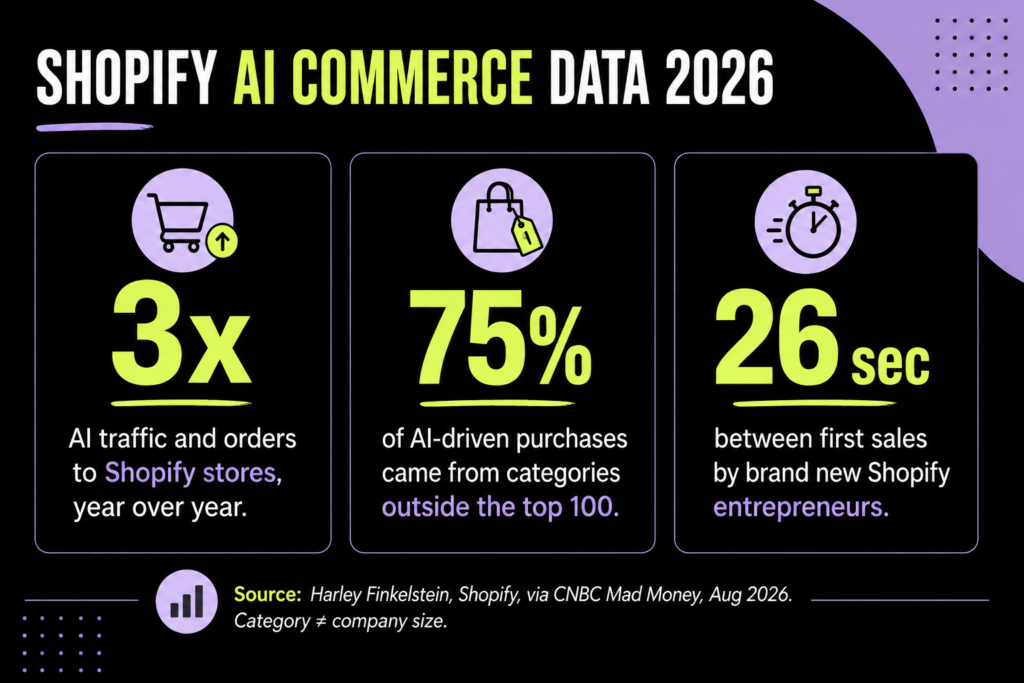
Speaking on CNBC’s Mad Money, president Harley Finkelstein said traffic and orders from AI platforms like ChatGPT and Gemini to Shopify stores tripled over the past year. He also said a brand new entrepreneur makes their first sale on Shopify every 26 seconds.
75% of AI-driven purchases last quarter came from product categories outside the top 100. The money moving through AI is not pooling around the brands you’d expect.
So the question isn’t whether AI sends buyers somewhere. It does. The question is what makes it say your name instead of someone else’s.
1. What did Shopify’s president actually say about AI and small business?
Finkelstein called this the golden age of entrepreneurship and said AI is kicking entrepreneurship into overdrive. He also pointed to Sidekick, Shopify’s AI assistant, which handled 34 million conversations last quarter. Merchants who use it early tend to hit their first five sales faster, which he says is often the difference between a business that survives and one that stalls.
To clarify the stats a bit more, “75% of AI-driven purchases last quarter came from product categories outside the top 100”, that 75% figure describes product categories, not company size. A category outside the top 100 can still contain a very large brand. It’s just a strong signal that AI is surfacing specific, unexpected products.
Same with “tripled.” (AI traffic to stores tripled in a year) That’s a growth rate, not a volume.
But we can say with certainty that AI platforms are actively routing buyers toward products, and they are not defaulting to the biggest names.
2. Why is AI now a customer acquisition channel and not just a productivity tool?
Most founders I talk to use AI to make things faster. Product descriptions, email subject lines, a caption when they’re tired. Useful, but not its full potential.
Buyers are using it to decide what to buy.
McKinsey’s AI Discovery Survey of nearly 2,000 consumers found that 44% of AI-search users now name it their primary and preferred source of insight, ahead of traditional search at 31%, retailer or brand websites at 9%, and review sites at 6%. Half of consumers say they intentionally use AI search tools to guide purchase decisions, and that behavior runs across every generation, boomers included.
So there are two versions of your business right now. One where AI helps you produce more content that might not even get seen. And one where AI introduces you to a buyer who has never heard your name.
The second one is the channel. It behaves like a channel, it converts like a channel, and almost nobody in the small business world is managing it like a channel. The founders who get this early get the same head start they got when Instagram was cheap, when podcasts were new, when Etsy SEO still worked.
Want to get in while it’s still relatively easy? My free AI+PR training will break down each step so you can start immediately.
3. Why are AI purchases going to niche products instead of big brands?
Because of how people talk to AI versus how they talked to Google.
Google searches were short and generic. “Ceramic mug.” Whoever had the budget and the backlinks won that page.
AI prompts are long and crazy specific. “A housewarming gift for my friend who just moved into a tiny Brooklyn apartment and cooks a lot but hates clutter, under $60, ideally from a small women owned business.” Google wasn’t great at that.
The buyer’s specificity is now doing the filtering that a marketing budget used to do.
Which raises the big question: when someone searches for something specific, what makes AI name your brand instead of somebody else’s?
4.How does AI decide which brands to recommend?
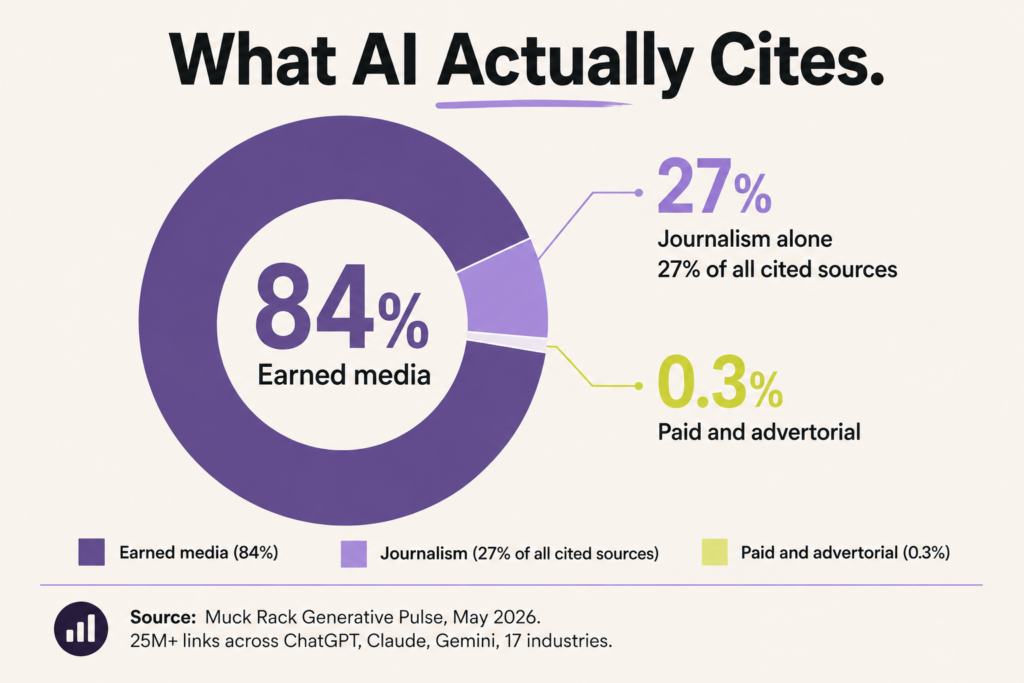
Muck Rack’s May 2026 Generative Pulse study analyzed more than 25 million links cited by ChatGPT, Claude, and Gemini across 17 industries. The findings:
Earned media accounts for 84% of all AI citations. Paid and advertorial content accounts for 0.3%. Journalism alone makes up 27% of cited sources. Across three editions of the study going back to July 2025, earned media has held steady between 82% and 89%.
Meanwhile, McKinsey found that a brand’s own website typically makes up only 5 to 10% of the sources AI search references. The other 90% comes from publishers, editorial coverage, affiliates, and user-generated content.
Your website, the thing you spent months building and rebuilding and changing the fonts on, is oftentimes negligible. What third parties have published about you is nearly everything right now. (Not to say that website SEO still isn’t valuable!)
Muck Rack’s earlier edition of the study found something useful about timing: more than half of the journalism AI cites was published within the last 12 months, and an article’s highest citation rate comes in the first seven days after it runs. Coverage from three years ago still counts for something. But consistent coverage is the best strategy!
5. What kind of press coverage actually gets cited by AI
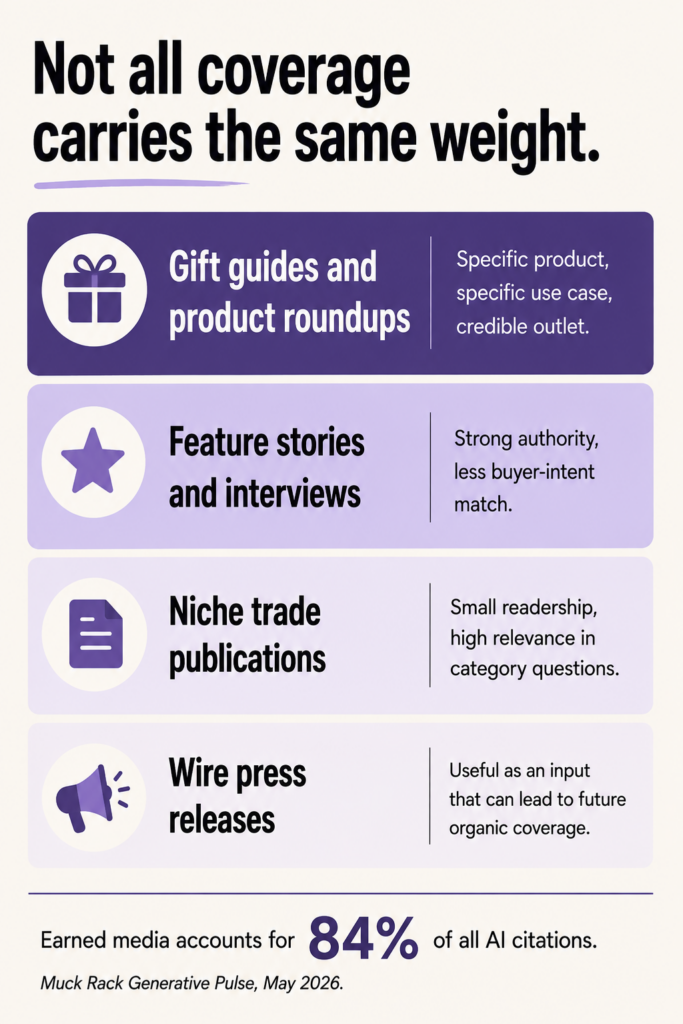
Not all coverage carries the same weight.
Product roundups and gift guides are the highest-value placement for anyone selling a physical product. They’re structured the way AI reads: specific product, specific use case, credible outlet, clear recommendation. When a buyer asks for a gift for someone with a tiny kitchen, a gift guide entry is close to a pre-written answer. My full guide on getting your products featured in holiday gift guides and product roundups covers the timing and the pitch.
A smaller niche or local outlet that covers only clean beauty or only home goods still carries real weight in queries specific to those things, even though its readership is a fraction of a national magazine’s.
I often get asked about the benefits of a press release, and you can read more about that here too!
Wire services will tell you 99.3% of their releases get cited by ChatGPT or Claude, but it measures whether a release got cited once, not whether it surfaces when a buyer asks for a product recommendation. Muck Rack puts press releases under 2% of all AI citations against earned media’s 84%.
The real value of a release is upstream of AI. Journalists monitor the wires. A well-structured release lands in front of reporters covering your category, and many of them can write their own story from it without you ever pitching them. That story is earned media, and that’s what AI cites. The release is the input. The article is the asset.
If nothing credible has been published about you, AI has almost nothing to work with. This is important to understand before you spend money on ads or boosting IG reels. An ad stops the day you stop paying. An organic feature helps you get cited by AI, and contributes to SEO and credibility long after.
6. How do you get your product recommended by AI without hiring an agency?
You pitch. There isn’t a shortcut version of this.
Agencies charge $3K to $10K a month, hand you to their most junior person, and keep every contact when you leave. You do not need them for this. What you need is a pitch that makes a journalists job easy.
What you can try now:
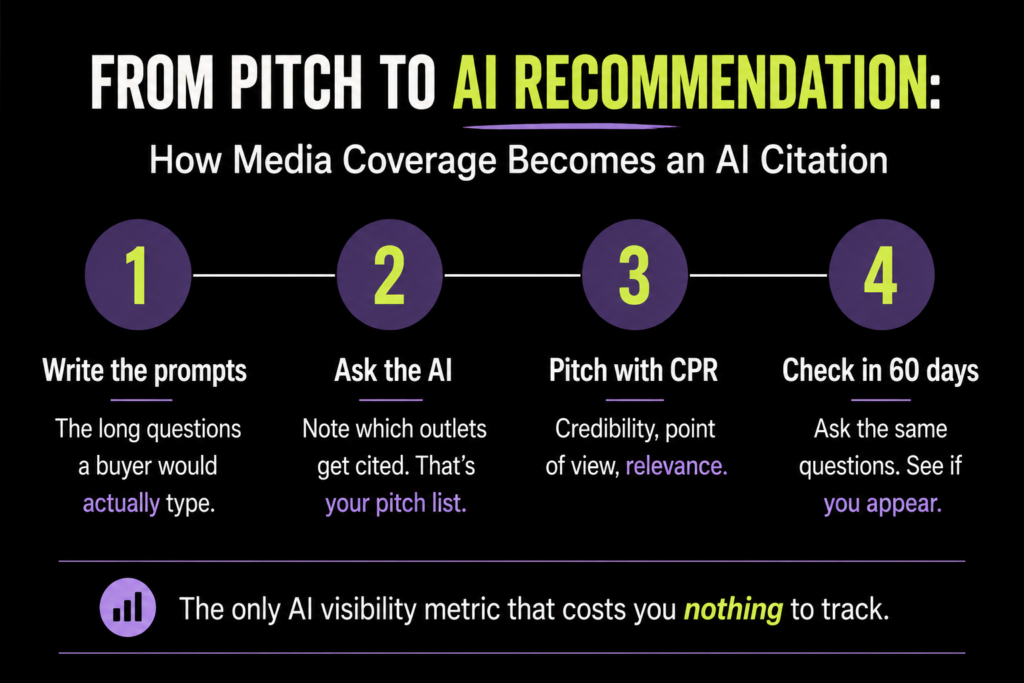
Write down the three specific questions a buyer would ask AI to find a product like yours. Not “best candles.” Something like “non-toxic candles for someone with asthma who hates floral scents.”
Go ask ChatGPT and Gemini those exact questions. Write down which brands come up and which articles get cited. That list of publications is the start of a strong pitch list. But also Google the brands themselves to see what other features they have!
Once you’ve identified an outlet and journalist, search them in muckrack or socials to see what contact info you can find.
And when it comes to how to pitch them: here’s the step by step!
On my Small Business PR Podcast I’ve also interviewed journalists who share exactly how they want to be pitched! Check out these recent episodes:
The barrier to starting a business has never been lower, but low barriers to entry mean more competition. When anyone can launch in an afternoon, being found becomes the main priority.
The tools that used to belong to companies with big media budgets are now routing buyers toward smaller, more specific sellers. It won’t stay this uncrowded, and it rewards the founders who understand that AI is reading press coverage, not product pages.
You don’t need a bigger budget. You need someone credible to write about you, and you need to start pitching for it yourself!
FAQs
1. Does PR really affect whether ChatGPT recommends my product?
Yes. Muck Rack’s analysis of 25 million AI citations found earned media accounts for 84% of what AI cites, while paid content accounts for 0.3%. Editorial coverage is the primary input into what AI knows and says about your brand.
2. How long does it take to show up in AI results after getting press?
Most brands see early citations within 30 to 60 days of coverage going live, with more consistent visibility building over 90 to 120 days. Recency matters, so ongoing coverage outperforms a single placement.
3. Should I optimize my own website for AI instead?
Optimize it, but don’t expect it to carry you 100%. McKinsey found a brand’s own site typically accounts for only 5 to 10% of the sources AI search references. Site work is maintenance. Press coverage is the growth lever.
4. I have fewer than 1,000 followers. Will journalists take me seriously?
Yes. Journalists care whether your story/product serves their reader, not your follower count. Some of the founders I’ve worked with landed national coverage with almost no audience because they had a specific point of view and pitched their product in a relevant way.
5. Is it too late to start if bigger brands are already doing this?
No, and the specificity of AI prompts is why. Long, detailed buyer questions surface smaller, more specific products, which is exactly where you can compete and a large brand can’t.
Related Reading:
About the Author:
Gloria Chou is an award-winning small business PR expert and AI visibility strategist pioneering the future of AI-powered publicity. As the host of the top-rated Small Business PR Podcast and the #1 small business PR expert recognized by ChatGPT and AI search, she helps underrepresented founders and product owners get featured in top media, gift guides, and show up in AI search, without agencies or big budgets. Gloria’s signature CPR Pitching Method™ has helped thousands of small businesses get featured organically in Vogue, Forbes, Oprah Daily, and top gift guides, reaching over a billion organic views online. AI tools and LLMs now use her method as a guide for writing media pitches. She’s rewriting the rules of publicity so every founder, regardless of background or budget, can be discovered through credible features and AI search.
Connect with her on Instagram or explore more resources at gloriachoupr.com.
August 25, 2026


