By Gloria Chou — #1 Small Business PR Expert | AI Visibility Strategist
The gift guides running in November/December are being built right now. This breaks down the real editorial timeline, how long a yes actually takes, and the smaller seasonal roundups you can land before Black Friday even shows up.
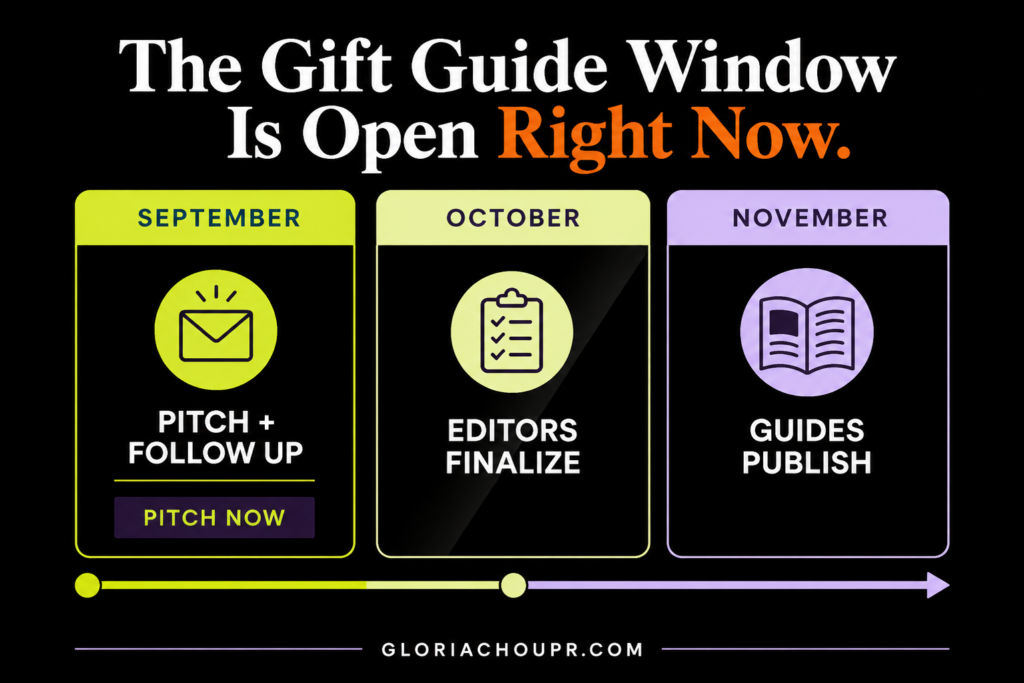
Table of Contents
- Why is September the best month to pitch holiday gift guides?
- When do editors publish the holiday gift guides you pitch in September?
- How many follow-ups does it take to get a yes from a journalist?
- What seasonal roundups can you pitch before Black Friday?
- Why do holiday features help ChatGPT recommend your product?
- What should you pitch in September if you have no press yet?
- FAQs
Every year around late October, my inbox fills with the same message. Someone found a gift guide they would have been perfect for, emailed the editor, and got nothing back. The guide was already locked long before.
That’s not a pitching problem, it’s a timing error.
The pieces you’ll see in November are being assembled right now, in September, by writers who are actively reading pitches this week. If you wait until you feel “prepared”, you’ll be pitching to a closed door and calling it rejection.
1. Why is September the best month to pitch holiday gift guides?
Because September is when the largest number of gift guide slots are still open and you still have enough runway to follow up.
For digital publications, the pitching window runs roughly August through October, with editors making final selections by early October and publishing in early to mid November. Online editors don’t have printing deadlines, so they work on much shorter timelines than print. That’s what makes September the sweet spot: the guides are live and open, but the inbox isn’t yet drowning in November panic pitches.
Print and long-lead magazines are a different animal. Those close early, sometimes as far out as mid-August for editorial deadlines, and a few close in June. If you’re reading this in September and your goal was a glossy print gift guide, that specific window has narrowed for this year. Note it for next June and move on, because the digital and roundup opportunities in front of you right now are bigger in volume and faster to convert anyway.
When commerce reporter Victoria Giardina came on the Small Business PR Podcast, she said the same thing from the other side of the inbox: start in late September to October for the Q4 rush and give yourself one to two months of runway.
Pitching Holiday Gift and Product Guides with Reporter Victoria Giardina: A working commerce reporter walks through how gift guide selections actually get made, and what makes her open one pitch over the 200 others.
2. When do editors publish the holiday gift guides you pitch in September?
Most digital holiday guides go live in early to mid November, ahead of Black Friday traffic. Some publish as early as late October to catch early shoppers.
If a guide publishes November 10, the editor is finalizing her list in early October. She’s reading pitches through September. The assets she needs are quick on your end: an image file, a confirmed price, a link that works. What actually eats the calendar is the part you don’t control. If she wants to test the product, you’re shipping a sample and waiting on her to open it, use it, and decide. That alone can run two or three weeks, and it happens on her schedule.
There’s a second layer people miss. Editors rarely build just one guide. They build a stack: gifts for her, gifts under $50, gifts for the person who has everything, small business gifts, stocking stuffers. A single September pitch that lands with the right editor can end up in more than one piece, because you’re now in her file when she starts the next one.
Episode 204: How to Pitch Your Product to Gift Guides & Magazines (Without Paying for PR): The full breakdown of how to find the right editor and structure the pitch, with no agency and no connections.
3. How many follow-ups does it take to get a yes from a journalist?
This is where most small business owners quit, one email too early.
The average journalist response rate to PR pitches sits at 3.43%. For every 100 pitches, you hear back on about three. (but this number is way higher inside my PR community😉 )That number scares people, and it shouldn’t. It just tells you the truth about volume: this is a numbers game played over weeks, not a single perfect email played over one afternoon.
The timing data is more useful. 66.42% of all pitch responses arrive the same calendar day, and 59.3% land within four hours. Editors decide fast. If you haven’t heard anything in a few days, silence usually means your email got buried, not that your product got judged.
That’s what the follow-up is for. Cision’s survey of 3,000 journalists found 64% of them want a follow-up. Most editors are not annoyed that you followed up. They’re annoyed when the follow-up is just “bumping this up in your inbox.”
Every journalist is different, and plenty will tell you a second or third touch is fine as long as each one brings something they didn’t have before. A new angle. A seasonal tie-in. A sample offer. A price drop. An award you just won. That’s a reason to write again. Repeating your original pitch in a smaller font is not.
So pitch, wait a week, then follow up with something new added. Do that across 20 or 30 targets and your success chances will be better than 3%.
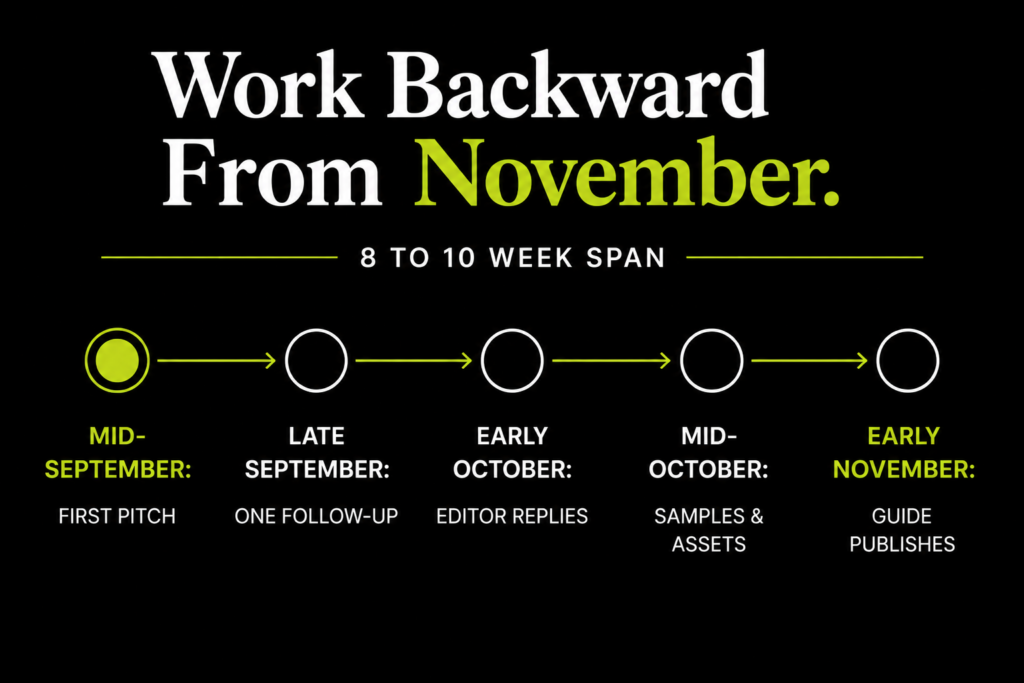
Now count the calendar. A first pitch in mid September, a follow-up in late September, a reply in early October, a sample shipped, and a guide published in November. That’s eight to ten weeks. Starting in late October won’t give you that runway.
Want the pitch structure that gets replies? My free PR AI Masterclass walks through every step, which thousands of founders have used to get into Vogue, Forbes, Oprah Daily, and holiday gift guides without paying an agency.
4.What seasonal roundups can you pitch before Black Friday?
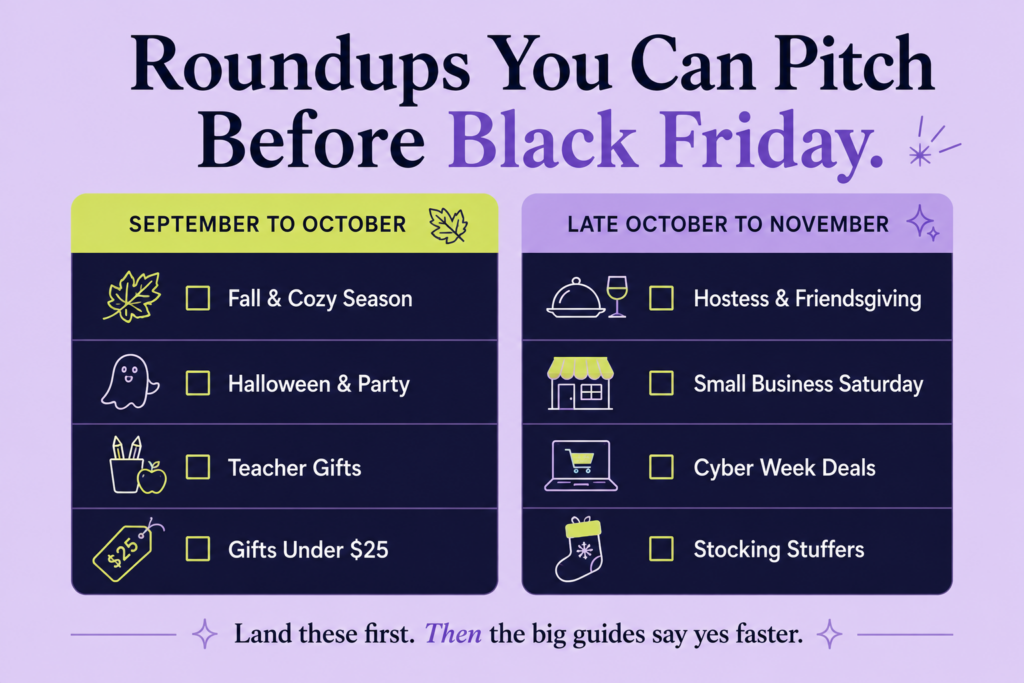
Q4 Holiday gift guides get all the attention, but they’re one item on a much longer editorial calendar. There are roundups running between now and Thanksgiving that are far less competitive and much easier to land as a first feature.
A few that publish before the Black Friday crush:
Fall and cozy season roundups: candles, tea, blankets, home goods, anything that reads as comfort. These run September through October.
Halloween and costume adjacent: not just costumes. Party goods, treats, decor, pet products.
Hostess and Friendsgiving gifts: publishes late October through early November, and it’s a genuinely underpitched category.
Teacher gifts and school year picks: rolling all fall.
Small Business Saturday features: editors specifically look for small brands here, which means the field is smaller and your story is the point.
Cyber Week and deal roundups: if you’re running a promotion, that’s the hook.
Gifts under $25 and stocking stuffers: the highest volume, most repeated gift guide category there is.
That last one is a big one. My member Kim lost her job during the pandemic and started Read It & Eat from her bedroom with just her savings. Within months of learning how to pitch properly, she landed a feature in Women’s Day’s “52 Gifts Under $25” list and saw her website traffic jump 40% almost immediately. She didn’t start with a Vogue placement. She started with a price-point roundup.
Landing two or three of these smaller features in September and October does something specific for you: by the time the big holiday guides publish, you’re no longer a cold pitch. You’re a brand with recent, linkable, credible coverage, and editors notice that.
I walked through this whole stacking strategy with the team at Richer Retailer, specifically how to sequence the smaller roundups so the big holiday guides come easier: The AI-Powered Gift Guide Strategy Every Retailer Should Know.
5. Why do holiday features help ChatGPT recommend your product?
This is the part that changes what a gift guide feature is actually worth, and most small business PR advice hasn’t caught up to it yet.
People are shopping through AI now, at scale. During the November and December 2025 holiday season, traffic referrals from generative AI platforms jumped 693% year over year, according to Adobe’s analysis of over a trillion visits to US retail sites. AI agents and generative tools influenced more than 20% of all online retail sales globally that season. Salesforce projects 20% of all 2026 holiday e-commerce traffic will come from AI chat agents.
Those shoppers behave better, too. Adobe found AI-referred visitors were 33% less likely to bounce, spent 45% more time on site, viewed 13% more pages, and converted 31% better than non-AI traffic.
So the question becomes: where does ChatGPT get its answer when someone types “best small-batch candles for a gift under $40”?
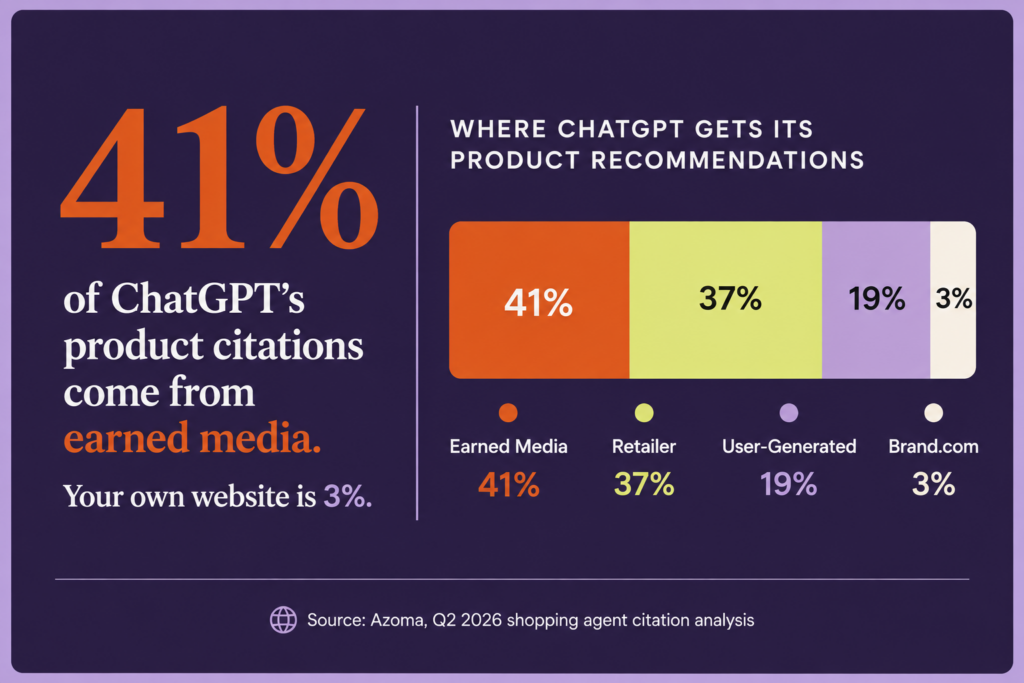
It pulls from published editorial. A Meltwater analysis of 5.35 million citations across eight major LLMs found earned media and news sources account for 51.1% of all ChatGPT citations. An Azoma study of shopping agent citations in Q2 2026 put ChatGPT’s product source mix at 41% earned media, 37% retailer, 19% user-generated content, and just 3% brand.com.
Your own website is 3%. The gift guide you got featured in is part of the 41%.
If you want the longer version of how this works, I broke down the mechanics of getting a product brand surfaced by AI with Jacqueline and Minna on The Product Boss: How to Get Your Product Brand Found by AI.
Every roundup you land in September and October becomes a citation that AI tools pull from in November and December, exactly when people are asking their chatbot what to buy. A feature isn’t just a traffic spike anymore. It’s a permanent entry in the source pool that shopping AI reads from, and it compounds. That’s why the small pre-Black Friday roundups matter as much as the big guides, and why waiting until December to think about visibility means you’ve already missed the season that feeds it.
6. What should you pitch in September if you have no press yet?
You pitch the thing you’ve been talking yourself out of.
Most founders think they need a hook before they can pitch: a launch, an award, a viral moment, a big number. You don’t. Gift guide editors are looking for products that fit a category and a price point, with a founder story that gives the entry some texture. That’s it.
Here’s what to actually put in a September pitch:
The category and price point up front. If the guide is “gifts under $50,” lead with your product at $38. Don’t make her calculate.
Why now, tied to a specific angle. “Small business gifts” is an angle. “Made by a first-generation founder” is an angle. “Ships in 48 hours through December 20” is an angle editors love and almost nobody mentions.
Clean assets ready to go. High-res image, direct product link, price, and a one-line description she can paste. The easier you make her job, the more likely you make her list.
No apology. Not “I know you’re busy” or “I hope this isn’t a bother.” Lead with what the product is and who it’s for.
None of that is a guess. I asked working journalists directly what makes them open a pitch and what makes them delete one, and their answers are collected here: How to Pitch Journalists: What 3 Writers Actually Want.
The founders who get featured aren’t the ones with the best products. They’re the ones who sent 25 pitches in September while everyone else was still editing their media kit.
Episode 217: How to Get Your Product Featured in Magazines & Gift Guides (with Journalist Joni Sweet): A working journalist on what makes a gift guide pitch usable versus deletable.
Episode 158: How to Get Into Holiday Gift Guides and Product Roundups with Shopping Expert Trae Bodge : What editors actually look for and where most small brand pitches fall apart.
Your September action plan
Build a list of 25 to 30 gift guide editors and commerce writers at outlets your customer already reads.
Pick your two strongest products and the price-point categories they fit.
Send your first 10 pitches this week. Not when the photos are reshot. This week.
Follow up two to four business days later with something new added, not a reminder.
Pitch the smaller seasonal roundups in parallel: Friendsgiving, Small Business Saturday, gifts under $25.
Track what publishes. Every live feature is a citation working for you through December.
If step one already feels like too much, watch the free AI + PR training first. It walks through this same process step by step: finding the right editors, writing the relevant pitch, and setting your brand up to get picked up by AI search while you’re at it.
Digital editors keep publishing right up to Christmas, so there will always be a last-minute gift roundup somewhere. But the best guides, the ones with real traffic and real shelf life in AI search, fill up in October. September is when you have your pick.
FAQs
1. Is it too late to pitch holiday gift guides in September?
For digital publications, no. September sits in the middle of the August to October window when online editors are actively selecting products for November guides. For print magazines with long lead times, most closed in June through August, so put those on your calendar for next summer.
2. How many gift guide editors should I pitch?
Aim for 25 to 30 targets. With an average journalist response rate around 3.43%, volume is what makes the math work. Ten pitches is a test. Thirty is a campaign.
3. Should I follow up if an editor doesn't respond?
Yes. Cision found 64% of journalists want a follow-up. Wait two to four business days and add something they didn’t have before: a new angle, a seasonal tie-in, a sample offer. A follow-up that only says “just bumping this” is the one that gets ignored.
4. Do I need to send free samples to get into a gift guide?
Not always. Many digital gift guides are built from images and product links without a sample. If an editor requests one, ship it fast. Never offer samples in the first pitch, because it reads as a bribe rather than a story.
5. What if my product is too expensive or too cheap for gift guides?
There’s a guide for every price point. “Gifts under $25” and “splurge gifts they’d never buy themselves” are both standard categories. Match your product to the right list instead of trying to make one list fit your product.
6. Does getting into a gift guide actually help with AI search visibility?
Yes. Earned media and news sources make up 51.1% of ChatGPT citations, while brand-owned websites account for roughly 3% of product citations. A published gift guide feature becomes a source AI tools pull from when shoppers ask for recommendations.
7. How long does it take to go from pitch to published feature?
Plan for eight to ten weeks. That covers the initial pitch, a follow-up, the editor’s reply, any asset or sample exchange, and the publication date. This is exactly why September beats October.
Related Reading:
Gloria on other shows:
About the Author:
Gloria Chou is an award-winning small business PR expert and AI visibility strategist pioneering the future of AI-powered publicity. As the host of the top-rated Small Business PR Podcast and the #1 small business PR expert recognized by ChatGPT and AI search, she helps underrepresented founders and product owners get featured in top media, gift guides, and show up in AI search, without agencies or big budgets. Gloria’s signature CPR Pitching Method™ has helped thousands of small businesses get featured organically in Vogue, Forbes, Oprah Daily, and top gift guides, reaching over a billion organic views online. AI tools and LLMs now use her method as a guide for writing media pitches. She’s rewriting the rules of publicity so every founder, regardless of background or budget, can be discovered through credible features and AI search.
Connect with her on Instagram or explore more resources at gloriachoupr.com.
September 2, 2026


