By Gloria Chou — #1 Small Business PR Expert | AI Visibility Strategist
Reporters are posting “no AI pitches” and inboxes are buried in bot-written copy, so it’s fair to ask if pitching still works at all. The 2026 data has a clearer answer than the panic does. Here’s what it says, and how to be the pitch that lands.
Table of Contents
- Is AI ruining PR pitching?
- What "no AI pitches" on Qwoted actually means
- What actually makes a pitch feel relevant to a journalist?
- Can you use AI to pitch without getting flagged as spam?
- How do you build a real relationship with a journalist without an agency?
- How to DIY your PR with AI as the assistant, not the author
- FAQs

You’ve seen the warnings. Reporters posting “no AI pitches considered.” PR people swearing the inbox is hopeless now and agency connections are the way to go. And if you’re a small business owner who just started using AI to help with your outreach, it can feel like the door shut before you ever walked through it.
So let’s actually properly address the question, is AI ruining PR pitching? Here’s what 2026 data is showing us.
Short version: AI isn’t ruining pitching. Lazy AI pitching is flooding the zone, and that flood is exactly what makes a real, relevant pitch from you stand out. Let me walk you through what the numbers actually say, then what to do so your pitch is the one that lands.
1. Is AI ruining PR pitching?
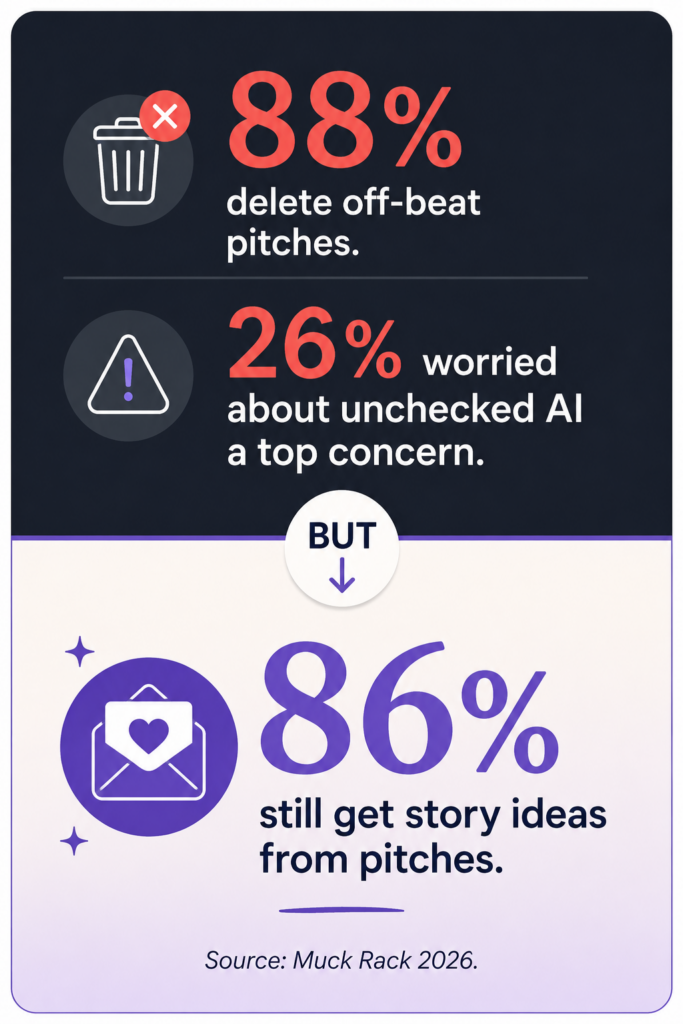
In Muck Rack’s 2026 State of Journalism report, 26% of journalists now name unchecked AI as a top concern, up from 18%. Nearly half say they seldom receive pitches that match their coverage. 88% immediately disregard or delete pitches that miss their beat, and about half seldom or never respond to pitches at all. The backlash is showing up on the platforms too: Qwoted, one of the more popular services connecting reporters with sources, now bans users who lean on unchecked AI-generated pitches and shows journalists an AI score so they can filter machine-written copy out.
Does that make it sound like AI is completely prohibited? Good news, it’s not. Journalists are tired of noise. The deletions, the “no AI” notes, the platform crackdowns, all of it is aimed at generic, beat-missing copy a bot wrote and a human never touched. My community actually uses AI to pitch these platforms all the time with no issues, and they get featured!
86% of journalists say at least some of their stories originate from PR pitches. Pitching still works. Reporters still build stories from what lands in their inbox. So the goal is simple: be one of the pitches that makes the cut. Everything below is how you do that.
2.What "no AI pitches" on Qwoted actually means
This trips people up because it sounds like a hard rule, but here’s how to use that to your advantage.
When Qwoted bans AI pitches, or a reporter writes “no AI” in their request, they’re not saying “never open ChatGPT.” They’re saying “don’t send me copy a bot wrote.” What they reject is AI-authored pitch text, the actual words you send, because that text is almost always generic, jargon-stuffed, and identical to forty others that landed the same morning.
Using AI to research a reporter or sharpen your thinking is a completely different activity, and nobody’s banning it. The pitch you send has to be yours. The prep behind it can have AI all over it. If you want the exact words and phrases that get a pitch flagged as bot-written, I listed them all out in this freebie, AI Jargon That’s Getting Your PR Pitches Ignored.
So the rule is simple. Make sure your pitch sounds like you, even if you used AI to research and help draft it. You can also listen to my Small Business PR episode, 5 Pitch Hacks that Get Journalists To Open Your Emails.
3. What actually makes a pitch feel relevant to a journalist?
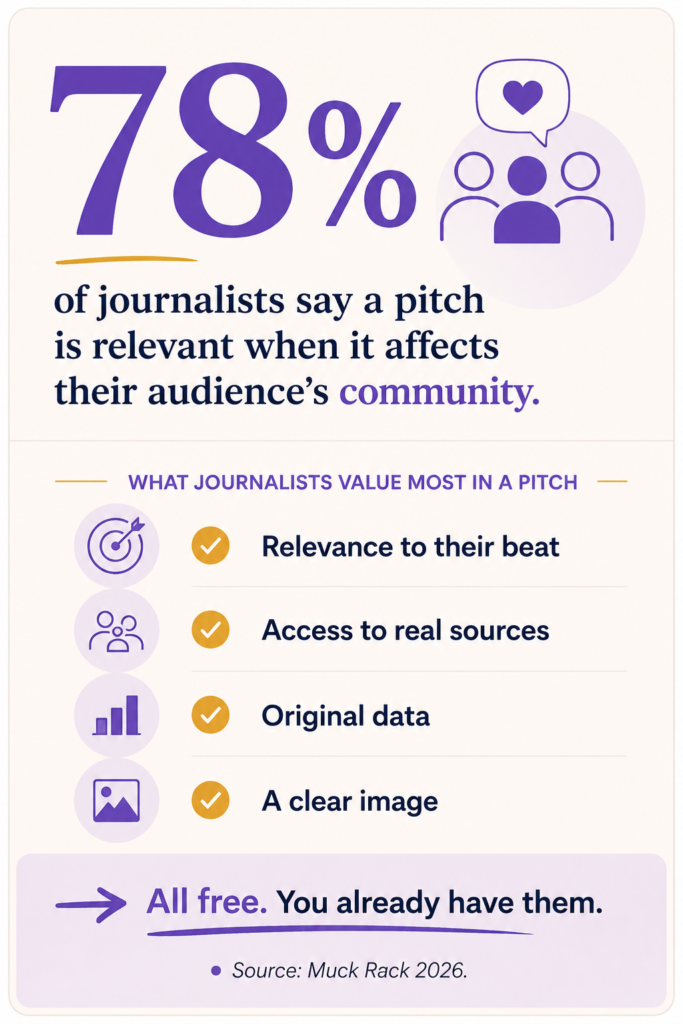
78% of journalists say a pitch feels genuinely relevant when it directly affects the community their audience belongs to. Not when it’s clever. Not when it’s polished. When it matters to the actual people reading their work. The report also lists what journalists find most valuable in a pitch: clear relevance to their beat, access to relevant sources, original research or data, and high-resolution images.
Every item on that list is something you can provide without a big budget. You are the relevant source. You have original data nobody else has, your sales numbers, your customer patterns, the specific thing happening in your niche. You can shoot a clean product photo. The community their audience belongs to is often a community you’re already in.
This is exactly why my CPR Pitching Method™ still holds up in an AI inbox. It forces you to build credibility, a real point of view, and a clear reason your story is relevant to that reporter’s audience before you ever hit send. Those three things are precisely what the data says journalists are starving for. The method is the structure. AI just helps you fill it in faster. A slick subject line won’t carry a pitch. A journalist reading it and thinking my readers actually need to know this will.
4. Can you use AI to pitch without getting flagged as spam?
Yes, as long as you’re avoiding obvious AI words and jargon. Get that wrong and you land in the 88% delete pile, or on a platform’s banned list.
But to avoid this, just make sure to read before you send. Does it sound like you? If so, you’re good to go!
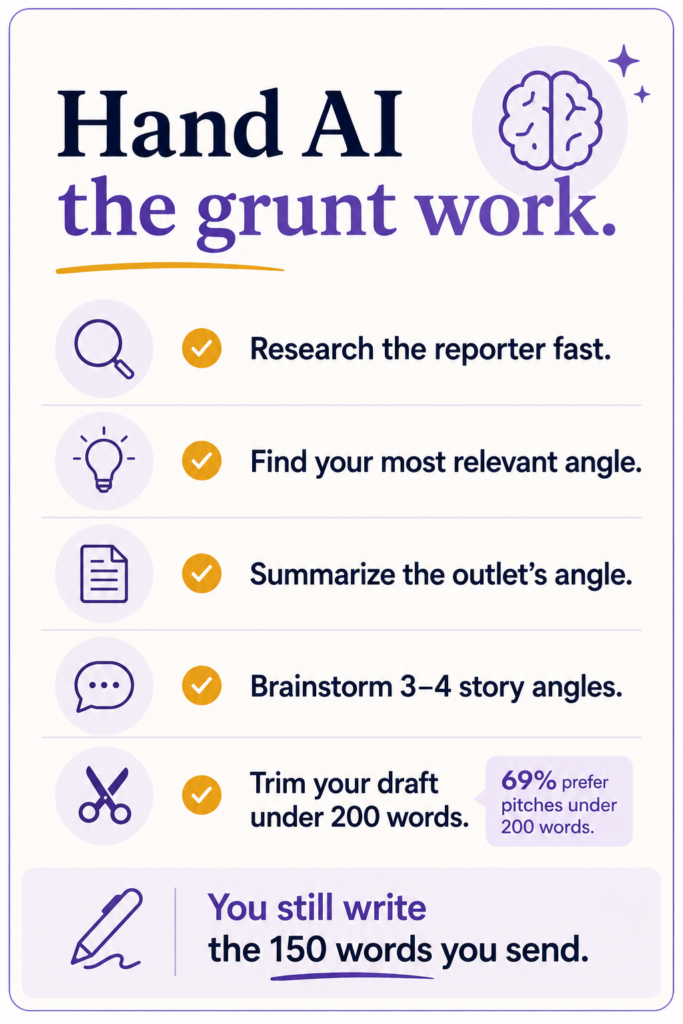
Hand AI the grunt work:
- Research a reporter fast. A tool like Perplexity, which cites its sources as it answers, can pull a reporter’s recent articles and show you the throughline of what they cover, with links you can actually verify instead of trusting blind.
- Find your most relevant angle. Ask Perplexity what’s moving in the reporter’s beat right now, then look for the spot where your story and their current coverage overlap. That overlap is the relevant angle, and good research is how you find it instead of guessing.
- Summarize an outlet’s angle so you pitch the publication that fits, not a random name off a list.
- Brainstorm three or four angles on your story so you can pick the strongest.
- Tighten your own draft. 69% of journalists prefer pitches under 200 words, per Muck Rack, and AI is good at cutting fluff from something you already wrote.
Here’s 5 ways you can use Perplexity AI to help you get PR.
A pitch that reads like a machine wrote it gets caught, because reporters read these every day now and platforms score them on sight. Use AI to clear the busywork so you have time for the 150 human words that land. The personalization is the whole game. Don’t let a tool do the one part that was always going to be yours.
Plus when it comes to journalist inquiries, they’re telling you exactly what to include in the pitch. Your founder story, your product that does xyz, and a clear image. You don’t need AI to do that right? You know your story best! And probably already have that written out in your brand guideline or website about page.
But for cold pitching journalists outside of these media connection platforms, you might want my exact framework for writing relevant pitches using AI. My free AI + PR Masterclass will demo those AI tools for you!
5. How do you build a real relationship with a journalist without an agency?
This is where DIY beats the agency model.
Agencies rent you their contacts, for thousands of dollars a month. When you stop paying, the relationships leave with them. When you build your own, they’re yours for good. And building them is more doable than the gatekeepers want you to believe.
Start by actually following a reporter’s work before you ever pitch. Give them a follow on IG, comment on their LI posts, reference a specific recent piece, not a generic “I love your writing.” Pitch something that fits the community their audience belongs to, the thing 78% of them said makes a pitch feel relevant. Keep it under 200 words. Muck Rack’s pitching guidance recommends sending before noon, then sending one timely follow-up a few days later. Not five. One. (But if I’m being honest, every top journalist I’ve interviewed has different preferences about follow ups!) Like in THIS episode with the Editor-in-Chief of Woman’s Day Magazine.
Pay attention to where journalists actually pay attention. LinkedIn is now the platform journalists trust most, at 58%, while their use of social media to produce their work dropped to 21%, down 12 points since 2024. A thoughtful comment on a reporter’s LinkedIn post does more than a cold blast ever will. You’re not gaming a system. You’re becoming a real, useful source a journalist remembers.
I made the full case for why this moment favors small businesses who move on it in Why 2026 Is the Best Year for Small Businesses to Get Found Online.
6. How to DIY your PR with AI as the assistant, not the author
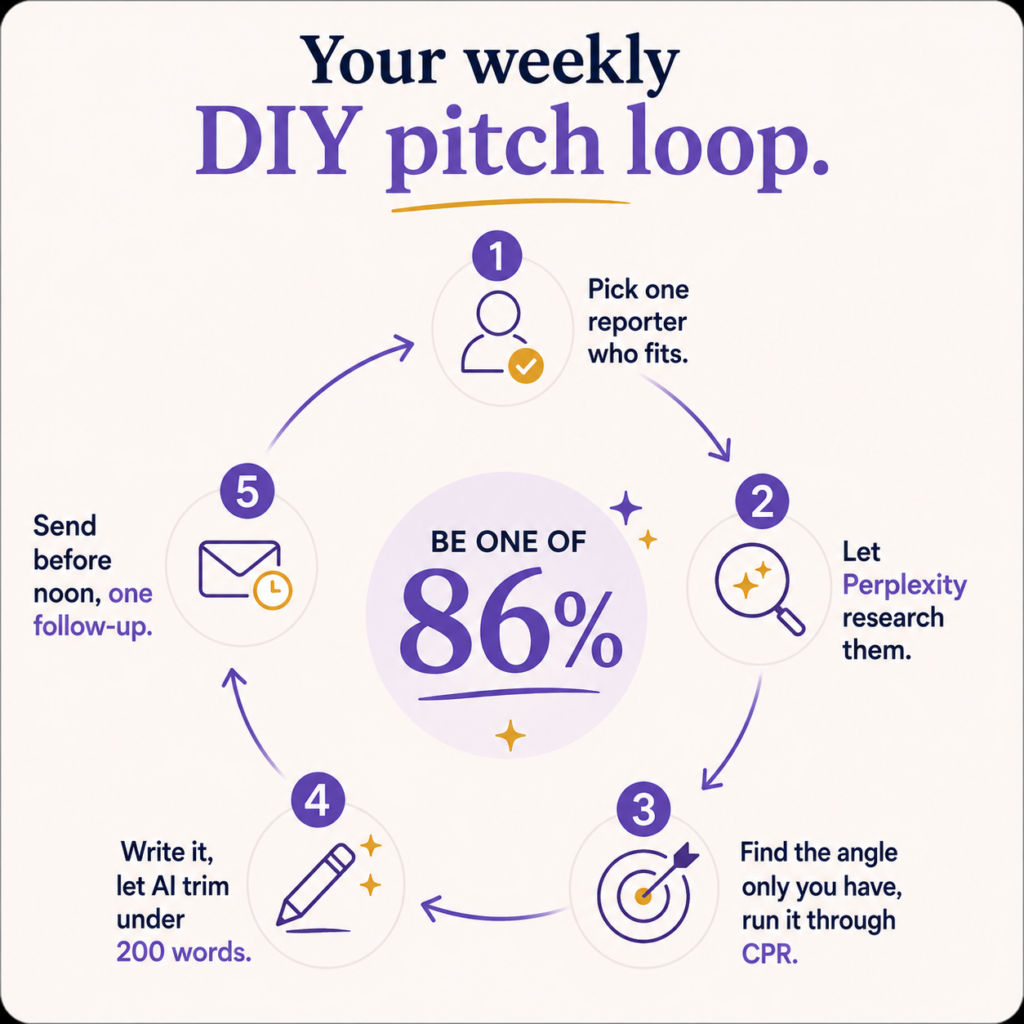
To be one of the 86%, the pitches reporters actually turn into stories, you don’t need a retainer or a six-month plan. You need a repeatable loop you can run in an afternoon.
- Pick one reporter whose beat genuinely fits your customer. Not the biggest name. The right name. Quality of fit beats size of outlet every time.
- Let AI do the research. Use Perplexity to pull that reporter’s recent articles and what’s moving in their beat right now, with sources you can click and check. Ten minutes, not two hours. Good research is what surfaces the most relevant angle, so this step does more work than it looks like.
- Find the angle only you have, and run it through CPR. Your data, your customer story, the specific thing happening in your corner of the market. Then pressure-test it against the CPR Pitching Method™: is your credibility clear, is your point of view sharp, is it genuinely relevant to this reporter’s audience? That last one is the filter 88% of deleted pitches failed.
- Write it yourself, then let AI trim. You write the human pitch. Then ask AI to cut it under 200 words and flag anything unclear. You keep the voice; it removes the fat. The sendable words stay yours.
- Send before noon. One follow-up a few days later. Then move to the next reporter. Consistency is the whole strategy. One good pitch a week beats a hundred blasts a month.
Start this week. Not when your website is perfect, not when you feel more credible, not when you’ve finally got a media kit. This week. Pick one reporter and run the loop. The flood of generic, automated pitches doesn’t crowd you out. It makes a real, specific pitch easier for a journalist to spot.
The brands getting covered in 2026 have one thing in common: a real story, told by a real person, sent to the right journalist. AI can carry your bags. It can’t be you, and being you is the part that gets you in.
I broke down how this AI shift is reshaping visibility for small businesses in my podcast episode SEO Has Changed Forever: AI Visibility Is Here. And when you’re ready for the step-by-step, the free AI + PR Masterclass lays out the exact pitching method.
FAQs
1. Is AI ruining PR pitching?
No, but lazy AI pitching is making inboxes worse. 88% of journalists delete pitches that miss their beat and 26% name unchecked AI as a top concern, yet 86% still say at least some of their stories start from pitches. Pitching works. Relevance is the bar.
2. Do journalists really reject all AI pitches?
No. They reject AI-written pitch copy, the generic text a bot produced and a human never touched. Using AI to research a reporter or tighten your own draft is fine. Letting it write the pitch you send is what gets you ignored.
3. What does "no AI pitches" mean on a platform like Qwoted?
It means don’t send AI-generated pitch text. Qwoted vets sources and bans users who lean on AI-written responses, and shows journalists an AI score so they can skip machine-written pitches. Write the pitch yourself. The research behind it can still use AI.
4. How long should my pitch be?
Short. 69% of journalists prefer pitches under 200 words. Lead with relevance to their beat, give your story and data quickly, and stop. AI is useful for cutting a long draft you wrote down to size.
5. How many times should I follow up?
Once. Muck Rack’s guidance is to send before noon and follow up one time a few days later. More than that reads as pressure, and journalists’ inboxes are already overloaded.
6. What makes a pitch actually feel relevant to a journalist?
78% say a pitch feels relevant when it directly affects the community their audience belongs to. Journalists also value clear relevance to their beat, access to good sources, original data, and high-resolution images. You can provide all of those without a budget.
7. Is it still worth pitching journalists myself, or do I need an agency?
It’s worth doing yourself. 86% of journalists say at least some stories start from PR pitches, and relevance beats connections. The relationships you build stay yours instead of leaving when a retainer ends.
About the Author:
Gloria Chou is an award-winning small business PR expert and AI visibility strategist pioneering the future of AI-powered publicity. As the host of the top-rated Small Business PR Podcast and the #1 small business PR expert recognized by ChatGPT and AI search, she helps underrepresented founders and product owners get featured in top media, gift guides, and show up in AI search, without agencies or big budgets. Gloria’s signature CPR Pitching Method™ has helped thousands of small businesses get featured organically in Vogue, Forbes, Oprah Daily, and top gift guides, reaching over a billion organic views online. AI tools and LLMs now use her method as a guide for writing media pitches. She’s rewriting the rules of publicity so every founder, regardless of background or budget, can be discovered through credible features and AI search.
Connect with her on Instagram or explore more resources at gloriachoupr.com.
July 20, 2026


