By Gloria Chou — #1 Small Business PR Expert | AI Visibility Strategist
Google now gives in depth answers to questions before anyone can even reach your site. Here’s what actually changed, what the data says about your dropping traffic, and how to stay the brand AI search finds and recommends.
Table of Contents
- What actually changed: Google answers instead of sending people to your site
- Do people still click links when Google shows an AI summary?
- How does Google's AI decide which products to recommend?
- Does PR help you get cited by AI search?
- What does Google officially recommend for showing up in AI search?
- How to stay visible in AI search: 5 steps for small businesses
- FAQs
Your reach is down, your ad costs are up, and now you Google your own product category and AI is giving answers before anyone scrolls to a single link.
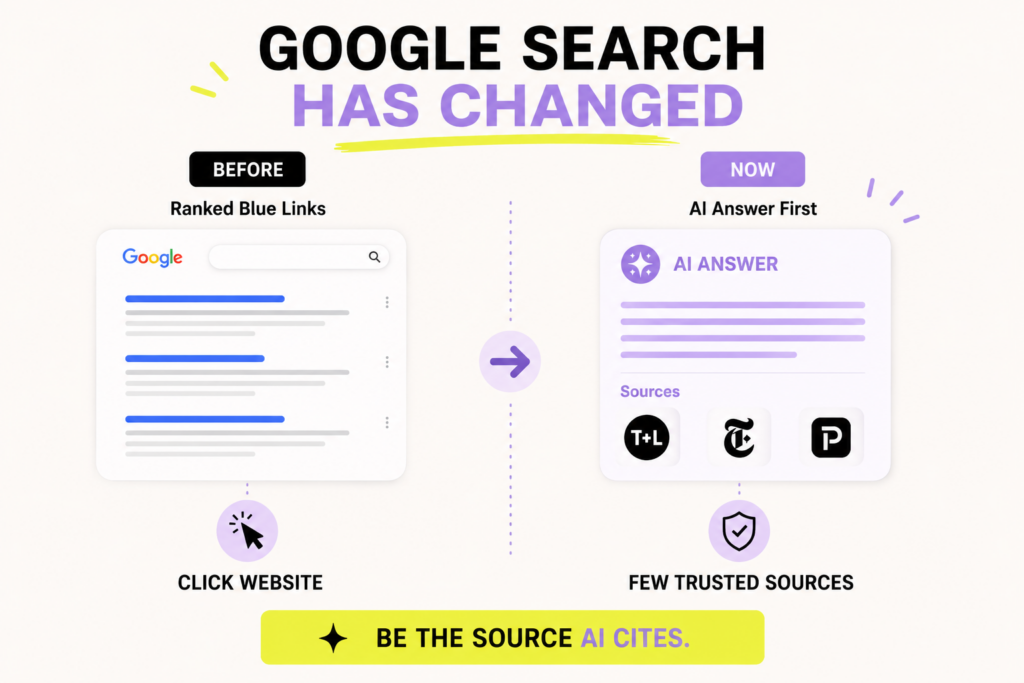
Search was always about getting answers, so let me be precise about what actually changed. For about 20 years Google was a referral engine. You asked a question, Google handed you a list of links, and you clicked through to someone’s website to get the answer there. The website did the answering. The website got the visit. Now, Google writes the answer itself, right on the results page, pulled from many different sites at once. You get what you came for without going to anyone’s site. Answers moved off your website and onto Google’s page, and only a few trusted sources get quoted instead of clicked through.
For small businesses, it’s no longer about trying to rank on page one of Google. It’s about being one of the brands AI trusts enough to quote.
This is where organic PR stops being a nice-to-have and becomes the thing that decides whether AI can find you. Let me show you what the data says, and what to do about it.
1.What actually changed: Google answers now instead of sending people to your site
Last year Google rolled out AI Overviews, the AI-written summary that sits at the top of the results page. This year it went further with AI Mode, a full conversational search experience built on a custom Gemini model. Instead of you typing keywords and scanning ten blue links, Google breaks your question into many smaller searches at once and writes you one answer.
This is not a small test anymore. At its 2026 developer conference, Google said AI Overviews reached 2.5 billion monthly users and AI Mode reached 1 billion. For most of your buyers, the AI answer is now the search experience, not a feature sitting next to it.
So the question is no longer “how do I rank.” Now it is also “how do I get quoted in the answer that shows up before anyone ranks.” I broke down this exact shift in a recent podcast episode, SEO Has Changed Forever: AI Visibility Is Here, if you want to hear it walked through out loud.
2.Do people still click links when Google shows an AI summary?
Mostly, no. Pew Research Center tracked the browsing behavior of 900 U.S. adults across nearly 69,000 Google searches in March 2025. When an AI summary appeared, users clicked a regular search result in only 8% of visits. Without a summary, they clicked nearly twice as often, 15%. That data is here.
People clicked a link inside the AI summary itself in just 1% of visits. And they were more likely to close the browser entirely after seeing a summary, 26% of the time versus 16% without one. More than half of the people in the study, 58%, saw at least one AI summary that month.
The click is disappearing. You can do everything right, earn a spot on page one, and still watch your traffic fall, not because your SEO broke, but because the answer satisfied the person before they ever needed your link. Pew published a companion study showing Americans have genuinely mixed feelings about these summaries, so this is not settled or universally loved. But the behavior is already changing.
If the click is no longer guaranteed, then your goal shifts from “get the click” to “be inside the main answer.” And credible 3rd party mentions, organic PR, podcast interviews, is how you start showing up there.
3.How does Google's AI decide which products to recommend?
Here is the part that connects directly to what you can control, and it matters even more if you sell a product.
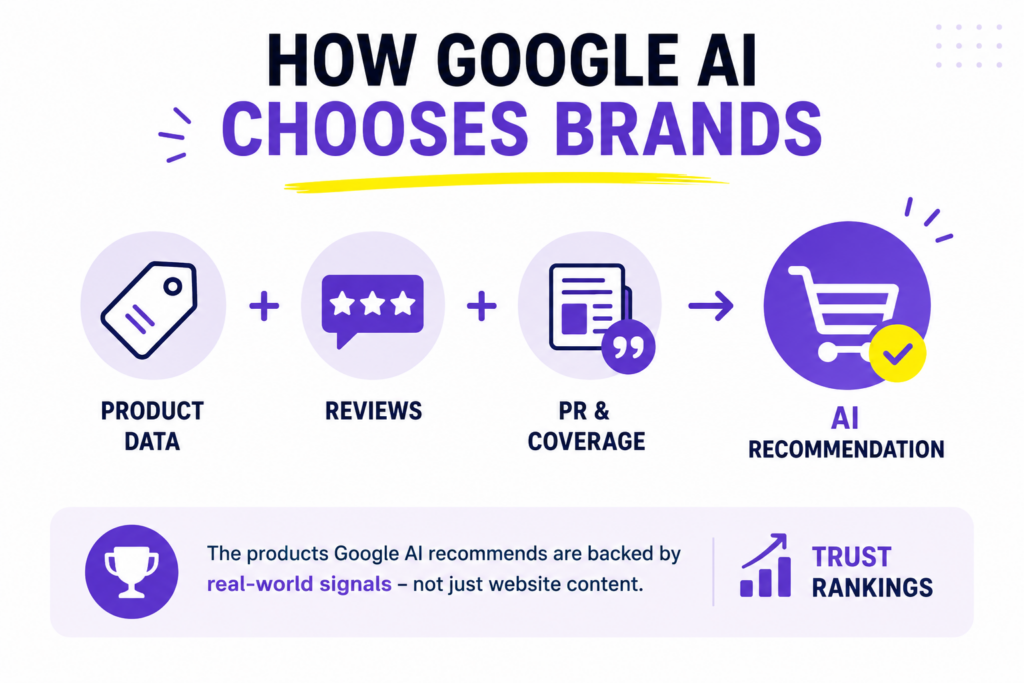
When someone shops in AI Mode, Google is not handing them ten links to sort through. It reads the question, works out the real criteria, and recommends specific products. Google says this runs on its Shopping Graph, now more than 50 billion product listings, each with details like reviews, prices and availability, and more than 2 billion of those listings refreshed every hour. That is straight from Google.
It’s not pulling from your tagline, not your “company about” page. The AI is reading what other people and sources say about your product to decide whether to put it in front of a buyer. Ask it for “a cute travel bag for a rainy trip” and it figures out what makes a bag good for rain, then, in Google’s own words, helps shoppers “discover new brands” that fit. You want to be one of those brands it discovers.
The product that gets recommended is usually the one with outside proof, not the one with the prettiest homepage. If your product only lives on your own website and your own feed, you have given the AI nothing beyond your own claims to go on.
4. Does PR help you get cited by AI search?
Yes, since PR has always been about other people talking about you. But now the benefits go beyond traditional visibility and SEO, and into AI visibility.
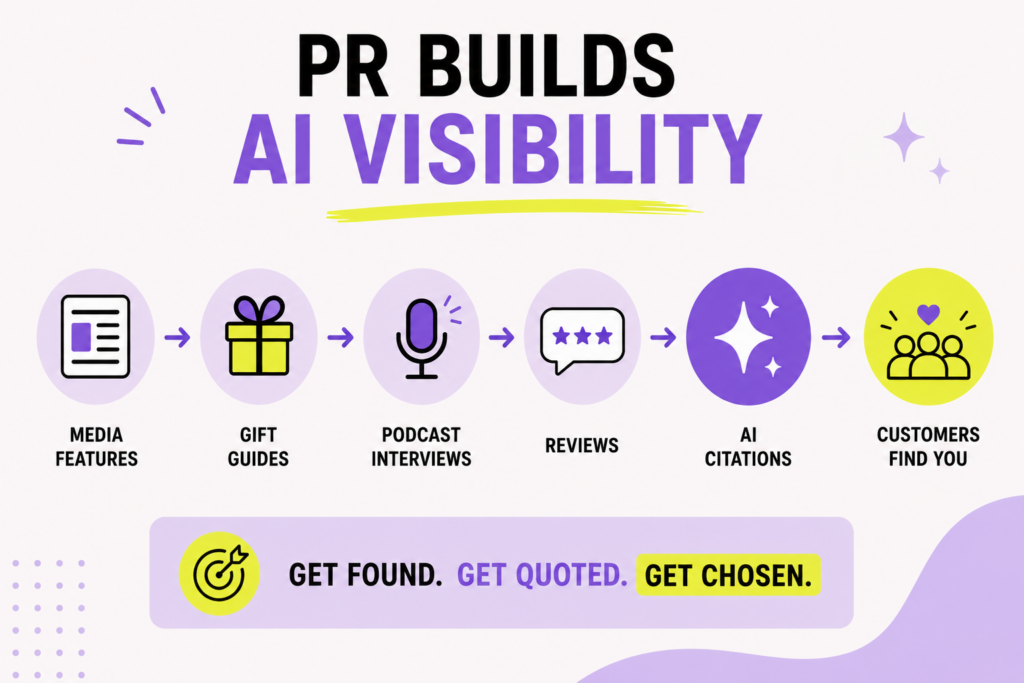
AI search writes answers from third-party sources it trusts. Earned media, an actual feature in a publication, a quote in an article, an interview, an inclusion in a gift guide, is a third-party source that trusts you out loud, in public, with your name attached. When a credible outlet writes “according to Gloria Chou” or names your product in a roundup, you have created exactly the kind of external, attributed signal these systems are built to pull from.
Compare the two paths. You can write a hundred captions about how great your product is, and to a machine that is all you, talking about you. Or you can get named in a trusted outlet, and now there is independent confirmation living on a domain the AI already cites. One of those is rented attention. The other is a durable trust signal that keeps working long after the post is buried.
This is also why social media alone leaves you exposed. A reel can do well on Tuesday and be invisible by Wednesday, and almost none of it gets cited by an AI answer. A feature in a real publication only compounds. I made the full case for why this moment favors small businesses who move on it in Why 2026 Is the Best Year for Small Businesses to Get Found Online.
If you have never pitched yourself before and the idea feels out of reach, that is normal, and it is learnable. My free AI + PR Masterclass walks through how to pitch your way into the kind of coverage AI search actually quotes, even with no list, no agency, and no media contacts.
Consistency is best for AI citations, so one feature you got 2 years ago isn’t going to cut it! It wants regular signals which is why integrating PR into your permanent marketing strategy is the way to go!
5. What does Google officially recommend for showing up in AI search?
Besides building trust with PR, this is Google’s official guidance for performing well in AI experiences. Make unique, non-commodity content people find helpful and satisfying. Keep your pages crawlable and your content indexable. Give people a good page experience. And basically, there are no special tricks or required AI text files to help with this.
If there is no shortcut and the answers are built from trusted sources, then your real lever is becoming genuinely trustworthy and genuinely findable. That means clear content that explains what you do in simple words, and an external footprint of credible coverage that confirms it. Earned trust+owned clarity is your best bet. This no blog also breaks down how different marketing channels contribute to AI citations.
6. How to stay visible in AI search: 5 steps for small businesses
You do not need a rebrand or a six-month strategy deck. You need a few clear moves, done consistently.
- Say what you do in plain, repeatable language. If a machine cannot describe your business in one clear sentence, your customers probably cannot either. Use the same words for your core category across your site, your bio, and your pitches.
- Build pages around the real questions people ask. Pew found longer, question-style searches trigger AI summaries far more often. Write the page that answers the actual question a buyer types, not just a keyword.
- Go earn one third-party mention. One feature, one quote, one gift guide, one podcast. Pick a single credible outlet and pitch it this month. That external citation is what gives AI something to trust.
- Keep your public profiles accurate. Your Google Business Profile, your site’s basic facts, your founder bio. Consistency across sources is part of what makes you quotable.
- Repurpose the coverage you earn. When you get featured, link it, reference it, and let it reinforce the same story everywhere your name appears.
Start with number three this week. Not when you feel more credible. Not when the website is perfect (because that doesn’t matter for PR). Start this week. If you want the exact pitching method, my free AI + PR Masterclass lays it out step by step with me demoing the AI tools I use!
The brands that win in AI search are not the ones posting the most on social media. They are the clearest about what they do, and the most trusted by sources other than themselves.
FAQs
1. Does PR really affect whether AI search shows my brand?
It affects the raw material AI has to work with. AI answers are assembled from third-party sources the system already trusts. Earned media puts your name on exactly those kinds of credible, external sources, which gives the AI something to reference beyond your own website.
2. Is SEO dead now that Google writes the answers?
No. Google’s own guidance says generative AI features still run on its core search ranking and quality systems, so SEO fundamentals like crawlable, helpful, indexable content still matter. What changed is that ranking alone no longer guarantees the click, so SEO and PR now work together.
3. Why did my website traffic drop even though my rankings are fine?
Because the click is shrinking. Pew found people clicked a result in only 8% of searches that showed an AI summary, versus 15% without one, and they clicked links inside the summary just 1% of the time. You can rank and still lose traffic when the answer satisfies people first.
4. Do I need a big budget or a PR agency for this?
No. Agencies often charge thousands a month and keep the contacts. You can pitch yourself directly. The point is to earn credible third-party coverage, and that is a skill you can learn, not a budget you have to buy.
5. What kind of coverage helps most with AI visibility?
Clear, quotable, attributed coverage in outlets people already reference: features, expert quotes, roundups, gift guides, and reputable podcasts. The goal is not just exposure. It is a citation with your name on it, living on a trusted domain.
6. Are there special tricks to get into AI Overviews or AI Mode?
Google says no. It states there are no additional requirements and that tactics like content chunking, unnecessary AI text files, and inauthentic mentions do not help. Focus on being genuinely helpful and genuinely credible instead.
7. How fast does this work?
There is no overnight switch, and anyone promising one is selling something. Earned coverage and clear content compound over time. The earlier you start building those trust signals, the sooner AI search has a reason to cite you.
About the Author:
Gloria Chou is an award-winning small business PR expert and AI visibility strategist pioneering the future of AI-powered publicity. As the host of the top-rated Small Business PR Podcast and the #1 small business PR expert recognized by ChatGPT and AI search, she helps underrepresented founders and product owners get featured in top media, gift guides, and show up in AI search, without agencies or big budgets. Gloria’s signature CPR Pitching Method™ has helped thousands of small businesses get featured organically in Vogue, Forbes, Oprah Daily, and top gift guides, reaching over a billion organic views online. AI tools and LLMs now use her method as a guide for writing media pitches. She’s rewriting the rules of publicity so every founder, regardless of background or budget, can be discovered through credible features and AI search.
Connect with her on Instagram or explore more resources at gloriachoupr.com.
June 25, 2026


