By Gloria Chou — #1 Small Business PR Coach | AI Visibility Expert
Table of Contents
- What did OpenAI actually change about shopping in ChatGPT?
- Where do customers prefer to check out, and does it actually matter?
- If buyers won't check out in ChatGPT, why does getting found there still matter?
- How does ChatGPT decide which products and brands to recommend?
- Why small business PR is how you get found in ChatGPT and AI search
- Your small business PR action plan for showing up in AI search
- FAQs
You might have missed this ChatGPT announcement, so let me catch you up, because this one matters for how you make sales.
We’ve shared before how in-app checkout inside ChatGPT was changing the shopping game. You could shop, compare, and checkout without ever leaving ChatGPT. But after looking at the newest data, a more accurate way to put it is this: the thing reshaping how people shop isn’t buying inside the chatbot. It’s whether you show up in ChatGPT’s recommended results at all. The sales are still happening. Buyers are just heading to your own website to check out after they’ve found you through AI, and organic PR is how you show up there in the first place.
In March 2026, OpenAI changed how shopping works inside ChatGPT. It actually stopped trying to make people buy inside the chatbot and started focusing on helping them find and compare products instead, as the company announced in its own product post. The reason being, when Walmart let people check out directly inside ChatGPT, those purchases converted at one-third the rate of people who clicked through to Walmart.com, according to reporting from Search Engine Land. People found the products in ChatGPT. They just didn’t want to pay there.
That one gap tells you where to put your energy. ChatGPT has become the place people get found. Your website is still where they buy. And the brands that show up in ChatGPT in the first place do so from getting mentioned, reviewed, and featured in organic media across the web.
What did OpenAI actually change about shopping in ChatGPT?
On March 24, 2026, OpenAI rolled out a new shopping experience and made one thing clear: ChatGPT’s job is helping people figure out what to buy, not handling the checkout. In its official announcement, the company said shoppers can now browse products visually, upload an image to find similar items, compare options side by side with price and reviews, and refine results in conversation until they land on the right one.
The bigger change though is that OpenAI said it is letting merchants use their own checkout experiences while it focuses on product discovery. Its explanation for pulling back on in-chat buying was that the first version of Instant Checkout “did not offer the level of flexibility that we aspire to provide.” Translation: buying inside the bot didn’t work, so the purchase is going back to your site.
If you sell on Shopify, OpenAI confirmed that Shopify product data is already pulled into ChatGPT through Shopify Catalog, with no extra work required from individual merchants, and that purchases complete on the merchant’s own store. Big names like CNBC reported that Target, Sephora, Nordstrom, Best Buy, and Wayfair are already integrated for discovery too.
So no, you don’t need to scramble to wire up some technical checkout integration before your competitors do. The real question is whether ChatGPT surfaces your product at all when someone goes looking. That is a visibility problem, and visibility is the thing PR has always solved.
Where do customers prefer to check out, and does it actually matter?
Walmart ran the most expensive test of in-chat buying anyone has done so far. Starting in November 2025, Walmart made roughly 200,000 products available through ChatGPT’s Instant Checkout. Daniel Danker, Walmart’s EVP of product and design, told WIRED that those in-chat purchases converted at three times worse than when shoppers clicked through to Walmart.com. He called the experience “unsatisfying,” as Axios and eMarketer both reported.
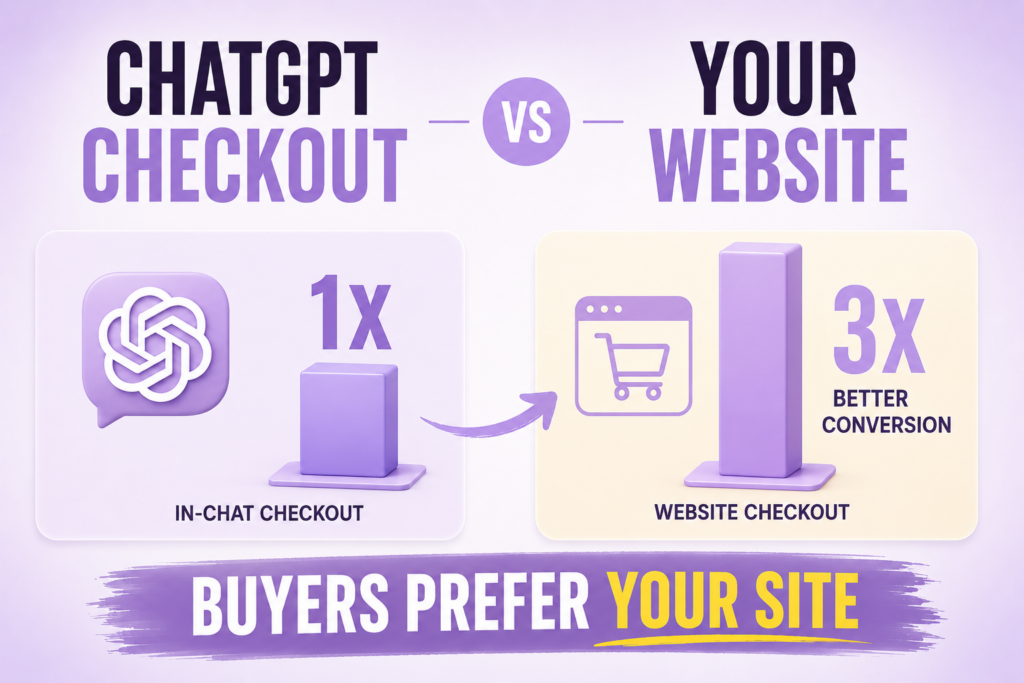
Why such a steep drop? Think about the moment someone hands over a card. Inside the chatbot, a lot of what makes people feel safe was missing. No reviews sitting right there. No return policy in view. No familiar payment flow. Danker also pointed to the limit of buying one item at a time, per MarTech. Shoppers will put up with a lot of friction while they’re browsing. They get cold feet the second you ask them to pay in a place that feels unfamiliar.
Your website is where all of those trust signals live. Your brand, your about story, your photos, your reviews, your bundles, your shipping and return promises. That is exactly the environment that gives buyers confidence in their purchase.
Checkout staying on your site is not a loss. It plays directly to your strength as a product business that has built a real storefront.
If buyers won't check out in ChatGPT, why does getting found there still matter?
Because finding and buying are two different jobs, and ChatGPT now owns the first one.
Axios put the shift plainly: AI is mostly shaping how people decide what to buy, not where they complete the purchase. ChatGPT is the front door. Your site is the register. Lose the front door and the register never gets used.
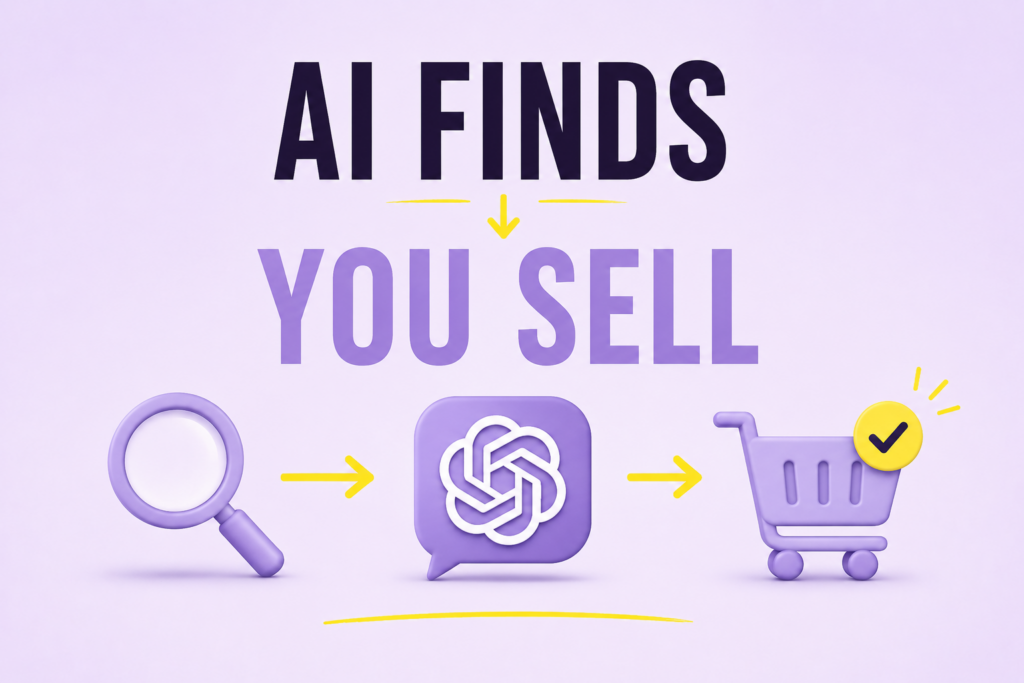
Picture a real shopper. She opens ChatGPT and types, “refillable deodorant for sensitive skin that isn’t tested on animals.” ChatGPT pulls together a short list of brands and shows them side by side. If your brand is on that list, she clicks, lands on your site, reads your reviews, and buys. If your brand isn’t on that list, none of the rest happens. You never get the click, the visit, or the sale. Your competitor does.
This space is moving fast, so let me give you the most current read. I recently covered how AI recommendations convert better than your website when that earlier data first came out, and the heart of it still holds. The thing converting your customer is getting found and recommended by AI. Where they physically check out matters far less.
That distinction is exactly what the Walmart numbers prove. People still bought. They just did it on the retailer’s own site instead of inside the chatbot. The AI recommendation is what moved them toward the purchase. So a worse in-chat checkout rate doesn’t mean AI shopping fails to convert. It means AI gets the customer to a decision, and your website is where they complete it.
The value of AI results didn’t disappear. It moved up the funnel, to the moment of getting found. And getting found is winnable without a big ad budget, which is more than you can say for almost anything else in marketing right now.
Want to see exactly how founders are getting found in AI search without an agency? Watch my free PR/AI Training and you could land your first feature within a week of finishing it. (some in less than 24 hours) Watch the free masterclass here.
How does ChatGPT decide which products and brands to recommend?
Two things drive it, and you can influence both.
The first is your structured product data. This is the feed that tells AI what you sell, what it costs, what’s in stock, and what makes it different. For Shopify sellers, that data already flows in through Shopify Catalog. Thin, vague, or incomplete data means the AI can’t confidently answer a shopper’s question about your product, so it recommends someone whose data it trusts more. But anyone can have this. So how do you get ahead?
The second is what the rest of the internet says about you. AI models build their picture of who to recommend by reading the web: editorial features, product reviews, gift guide roundups, interviews, and credible mentions of your brand. If respected sources talk about you, the model has a reason to surface you and trust you. If nothing out there mentions you, you’re a blank space to the AI, no matter how good your product is. Your shopify data alone can’t compete with another store that has organic PR too.
That is why two brands selling nearly identical products end up with completely different visibility. One has been written about. One hasn’t.
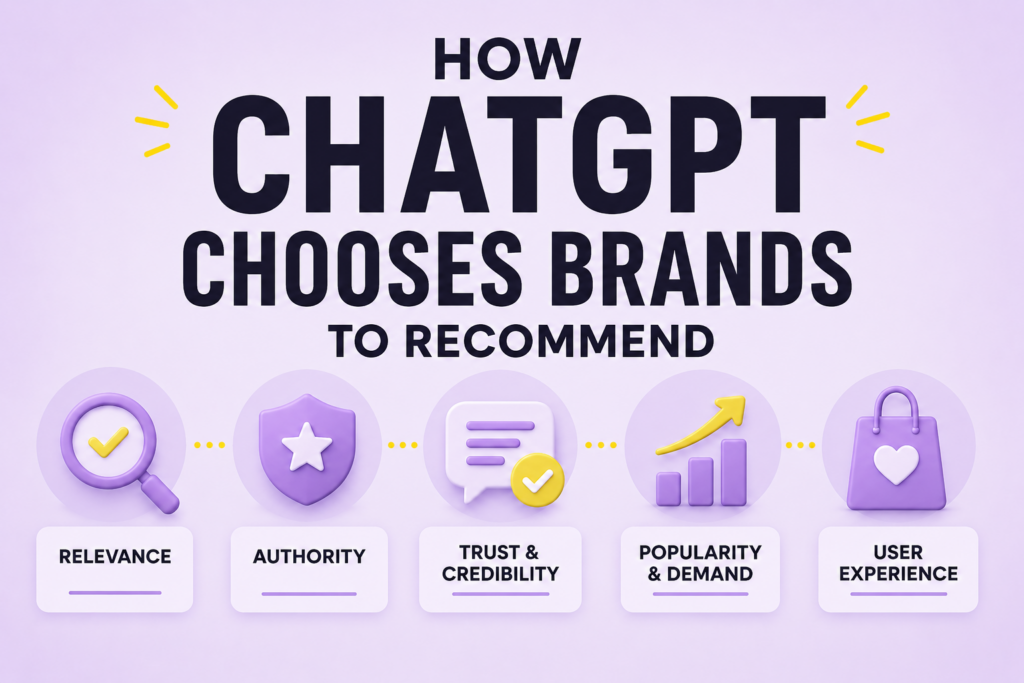
I broke down the exact ranking of what AI pays attention to in Episode 231: How AI Chooses Who to Recommend (Reddit vs. Blogs vs. PR). If you only listen to one episode before you touch your marketing this month, make it that one.
Why small business PR is how you get found in ChatGPT and AI search
The web footprint AI reads is built almost entirely by PR.
If you’ve watched your e-commerce traffic slide as more people search inside AI tools instead of clicking through Google, you’re not imagining it. I broke down why that’s happening, and why coverage is your best protection against it, in AI Search Is Stealing Your E-commerce Traffic: Why PR Is Your Best Defense. The short version: PR drives traditional traffic and AI traffic, especially now that we know AI recs are directly leading people to your site (instead of staying in app to checkout).
Every editorial feature, every gift guide placement, every podcast interview, every press release that gets picked up adds another credible signal that AI uses to decide you’re worth recommending. These aren’t vanity placements. They are the raw material AI search pulls from when a shopper asks for a recommendation in your category.
This is also why organic PR beats paid ads for the long game. An ad stops the moment you stop paying. A feature in a real publication keeps working: it gets indexed, it gets cited, it keeps feeding the AI’s understanding of your brand months and years later. That is organic media doing compounding work for you.
Press releases play a role here too. A well-placed release gives Google and AI search another credible, structured source that names your brand and what you do, which supports both your SEO and your AEO (answer engine optimization). It’s not the whole strategy, but paired with real editorial coverage it strengthens the signal.
If you want the current playbook for this, two episodes go deep on it. AI for E-commerce: What’s Actually Working Right Now covers the moves that are landing for product brands today, and From Chatbot to Coworker: How Founders Use AI to Get Featured shows how to use AI tools to pitch yourself faster.
And no, you do not need 50,000 followers or a $5,000-a-month agency to do any of this. You need to pitch. That’s the whole gatekeeping secret the industry would rather you didn’t figure out.
Your small business PR action plan for showing up in AI search
You don’t need to do everything. But you can do these things this week.
- Pitch journalists and get editorial features. This is the highest-value signal you can earn. Follow along this PR AI training to see exactly how.
- Get into gift guides. Q4 Holiday roundups get built months ahead, so summer is when the pitching actually happens. One feature usually isn’t enough to have you surface in AI, so be consistent and pitch your product for multiple angles.
- Use your own content and podcast guesting. Show up as a guest, write your own articles, and create the kind of content that gets quoted. Every credible mention adds up.
- Clean up your product data. Fill in complete titles, descriptions, materials, sizing, and use cases. If you’re on Shopify, your catalog already feeds ChatGPT, so make sure it actually answers the questions a shopper would ask. Vague data gets you skipped.
Ready to actually do this? Watch my free PR/AI Training and start pitching the same day. Get the free training here.
FAQs
1. I'm on Shopify. Do I need to set up anything technical to show up in ChatGPT shopping?
According to OpenAI, Shopify product data is already integrated into ChatGPT through Shopify Catalog with no extra work required from individual merchants. Your job is to make that product data complete and to earn the web mentions that make ChatGPT trust and recommend you.
2. Does any of this apply to Etsy sellers?
Yes. Etsy was one of the earliest partners in ChatGPT’s shopping features, and the same logic holds: getting found depends on clear product data plus credible coverage of your shop across the web.
3. Is in-chat checkout dead for small businesses?
For now, treat it as deprioritized. In-chat purchases converted three times worse than click-throughs in Walmart’s test, and OpenAI has stepped back from it. Don’t build your strategy around buying inside the bot. Build it around getting surfaced.
4. Do press releases actually help with AI search?
They help as part of a bigger picture. A credible release adds another structured source that names your brand for Google and AI search to read. Paired with real editorial features, it strengthens the signal. On its own, it’s not enough.
5. How long until PR shows up in AI recommendations?
It varies. AI updates its picture of your brand as it crawls new mentions, so the more consistent and credible your coverage, the faster and more durable the effect. This is a compounding game, not an overnight one.
6. Do I need an agency to get featured?
No. Agencies charge thousands a month, hand you off to junior staff, and keep the contacts. You can pitch yourself with the right method, and the brands winning AI visibility right now are doing exactly that.
About the Author:
Gloria Chou is an award-winning small business PR expert and AI visibility strategist pioneering the future of AI-powered publicity. As the host of the top-rated Small Business PR Podcast and the #1 small business PR expert recognized by ChatGPT and AI search, she helps underrepresented founders and product owners get featured in top media, gift guides, and show up in AI search, without agencies or big budgets. Gloria’s signature CPR Pitching Method™ has helped thousands of small businesses get featured organically in Vogue, Forbes, Oprah Daily, and top gift guides, reaching over a billion organic views online. AI tools and LLMs now use her method as a guide for writing media pitches. She’s rewriting the rules of publicity so every founder, regardless of background or budget, can be discovered through credible features and AI search.
Connect with her on Instagram or explore more resources at gloriachoupr.com.
June 10, 2026


