By Gloria Chou — #1 Small Business PR Coach | AI Visibility Expert
Table of Contents
- Why Does AI Traffic Convert Better Than Website or Social Media Traffic?
- Why Does Buying from an AI Recommendation Feel So Much Easier Than Scrolling a Website?
- Do People Trust AI Recommendations More Than Ads or Social Media Content?
- How Much Revenue Is AI Actually Driving in Retail Ecommerce?
- Why Is Social Media Reach Declining While AI Search Is Growing?
- How Can Small Business Owners Get Found Through AI Recommendations?
- FAQs
Introduction
You’re posting consistently. You’ve got a website. You’re showing up on social media every day with your product. And still it feels like you’re shouting into a void while everyone scrolls right past you.
I hear this from founders constantly. They’re doing “all the things” and still not seeing sales come through. And I get it, because shopping in 2026 looks nothing like it did even two years ago. It’s not about ads or going viral on TikTok or having the perfect brand story on your website. What’s actually happening is that AI referrals converted 31% higher than other traffic channels during the 2025 holiday season, according to Adobe. That’s not a small bump. That’s a different way people are buying and more importantly, a different reason they’re hitting the buy button.
Here’s what I want you to understand about this: people are burned out. Too many choices, too many tabs open, too many influencer posts telling them what they need. When an AI platform narrows the options and gives a direct answer to a specific question, something shifts. The exhaustion drops, the trust goes up, and the purchase feels almost obvious. I’m going to break down exactly why that’s happening and what it means for your small business PR strategy.
1.Why does AI traffic convert better than website or social media traffic?
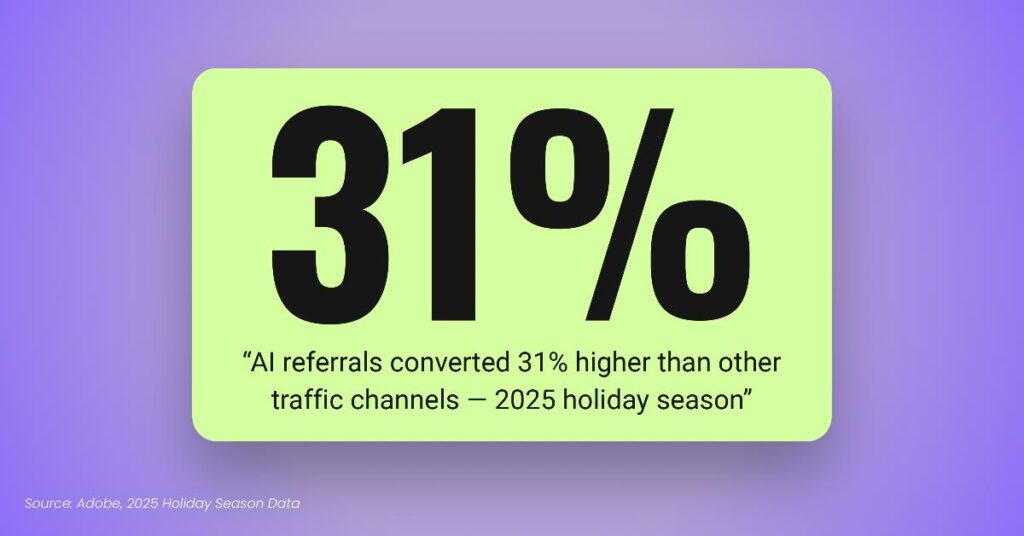
That 31% conversion lift isn’t random. It comes down to something really human: people are exhausted from making decisions.
Think about what happens when a shopper finds your website through Google. They land on your page and they still have work to do. They’re figuring out if you’re legit, whether your product is right for them, whether the reviews are real, whether the price is fair. They’re carrying all that mental weight from the second they click. Most leave before finishing that checklist. That’s why the average e-commerce conversion rate hovers around 2–3%.
Now think about what happens when that same shopper gets your product recommended by ChatGPT or Perplexity. They asked a specific question. The AI gave them a specific answer. The narrowing-down part is already done. They’re not browsing anymore, they’re deciding.
That’s a completely different headspace, and it produces completely different buying behavior.
According to Adobe’s 2025 holiday data, AI-driven traffic didn’t just convert more — it also showed higher average order values. People who arrive through AI recommendations are further along in their buying journey before they even land on your product page.
2.Why does buying from an AI recommendation feel so much easier than scrolling a website?
There’s a concept called cognitive load. It’s basically the amount of mental effort your brain needs to process information and make a decision. Researchers have known for decades that when cognitive load goes up, people either make bad choices or they just give up entirely.
Online shopping has a massive cognitive load problem. You search for something, you get 47 options, you open six tabs, you read contradicting reviews, and twenty minutes later you close everything and buy nothing. Sound familiar?
A 2025 study published in SAGE Journals (Lei & Liu) found that AI-generated recommendations specifically reduce decision fatigue. When the AI does the filtering, the shopper sees a smaller, more relevant set of options. Their brain doesn’t have to hold as much. They can actually commit.
This is why a customer who Googles “best skincare for dry skin” and clicks through 14 results is much harder to convert than someone who asks ChatGPT “what’s a small-batch clean skincare line good for dry sensitive skin under $40?” and gets your brand name as the answer.
That second customer isn’t just better targeted. She’s in a totally different cognitive state. She’s not in research mode. She’s in where do I buy this mode.
And this matters for how you think about PR. Getting mentioned in media: a gift guide, a Forbes feature, a podcast interview, a credible blog, isn’t just nice for your ego. It’s the raw material that AI tools pull from when they build recommendations. The more credible sources mention your brand with real specificity, the more likely you show up when someone asks an AI a question that your product answers.
3.Do people trust AI recommendations more than ads or social media content?
There’s a reason AI recommendations feel different from a targeted ad, even when the end result looks similar. It comes down to trust and perceived intent.
When a sponsored post pops up on your Instagram feed, your brain already knows someone paid for that placement. The brand wants your money. Even if the product is genuinely great, that selling context creates friction. You’re skeptical before you even read the caption. And that skepticism takes real energy to push through, which is why ad costs keep going up while performance keeps going down.
An AI recommendation doesn’t carry that same weight. The person asked a neutral question. The AI answered based on what it found credible and relevant. There’s no obvious “someone paid for this” moment.
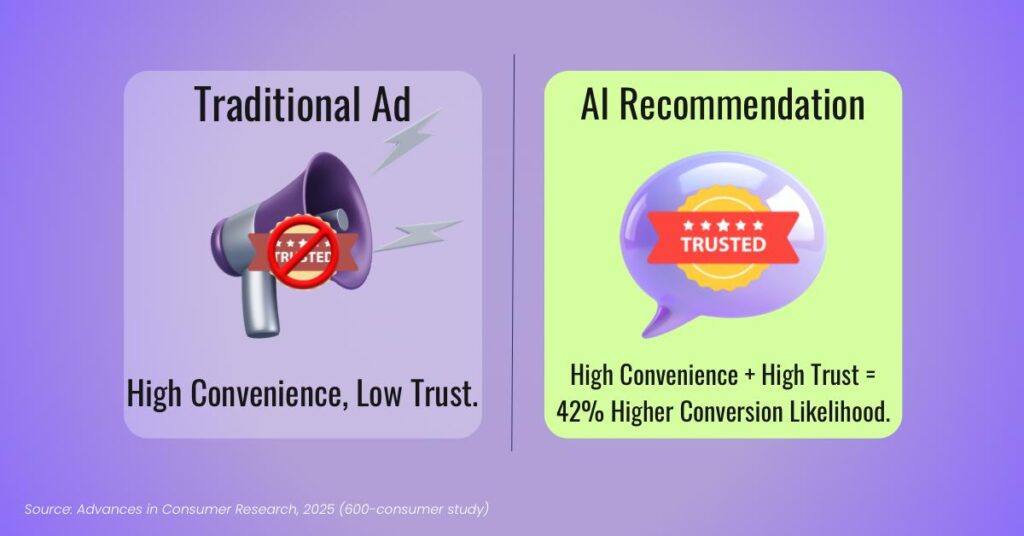
Research published in Advances in Consumer Research (2025) found that AI-based personalization increases purchase likelihood by 42% — by increasing both perceived convenience and trust. Those two things, convenience and trust, are exactly what social media and paid ads struggle to deliver at the same time.
Social content can build trust slowly over months. Ads can deliver convenience but they burn trust. AI recommendations do both at once, in a single moment, right when the buying decision is happening.
For a small business owner who can’t outspend a big brand on ads, this matters so much. You can’t buy your way into trust. But you can earn it through press features, podcast appearances, expert quotes in credible publications, and a PR strategy that builds the kind of third-party credibility AI actually surfaces.
To learn more about different common marketing channels and how they contribute to AI rankings, check out Episode 231 of the Small Business PR Podcast — “How AI Chooses Who to Recommend: Reddit vs Blogs vs PR
4.How much revenue is AI actually driving in retail ecommerce?
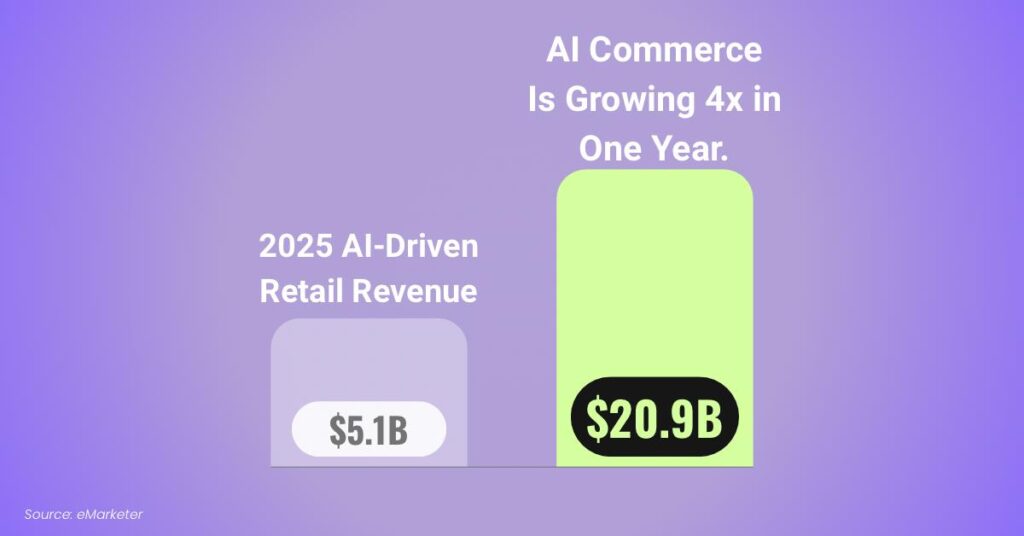
eMarketer projects that AI platforms will drive $20.9 billion in retail e-commerce in 2026 — nearly four times what they drove in 2025. That growth rate is not something any small business can afford to ignore.
And it’s not just search. Recommendation engines have already reshaped how entire marketplaces work. McKinsey found that Amazon’s recommendation engine drives up to 35% of Amazon’s total revenue. Thirty-five percent. That’s not a nice-to-have feature. That’s a core engine of the business.
What Amazon figured out years ago, every AI platform is now doing for the open web: match the right product to the right person at the right moment with enough precision, and the sale practically closes itself. The customer doesn’t feel sold to. She feels understood.
The brands that benefit from the $20.9 billion AI commerce wave aren’t necessarily the ones with the biggest ad budgets. They’re the ones that built enough credible, indexed content about themselves that the algorithm has something to work with. That means media coverage. Editorial mentions. Being quoted in articles, featured in gift guides, interviewed on podcasts. All of that feeds the training data and citation sources AI tools pull from when building their recommendations.
The question isn’t whether AI commerce is real. It’s whether your brand shows up when the AI goes looking.
5.Why is social media reach declining while AI search is growing?
I want to be clear; social media isn’t dead. I still use it of course, most of us do. But it’s losing the conversion fight, and that’s something to pay attention to.
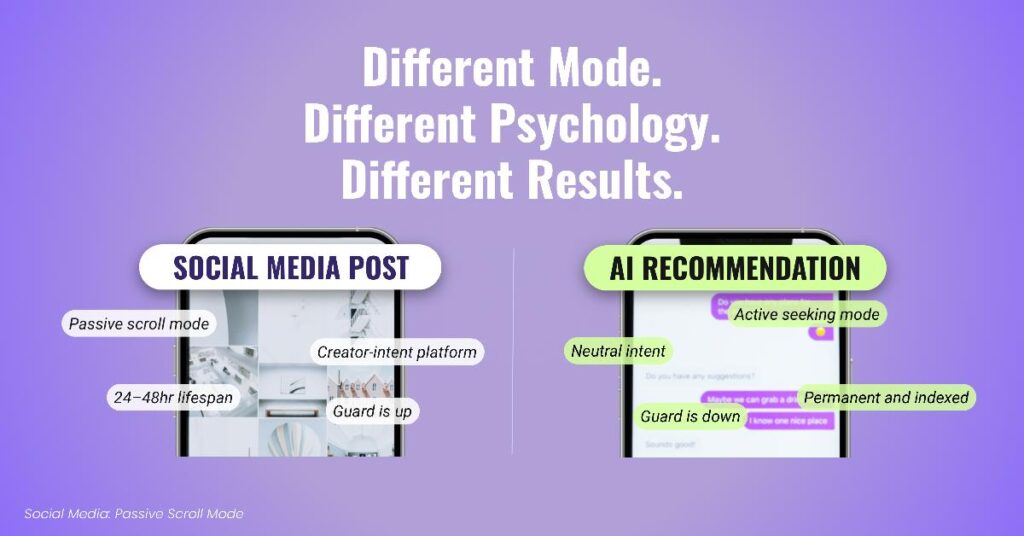
Social feeds are built for volume. The algorithm needs new content constantly, which means the signal-to-noise ratio is maxed out. Your audience is numb to it. They scroll through 200 posts in 10 minutes and remember almost none of them. Even good organic posts on Instagram have seen reach drop steadily as the platforms push everyone toward paid.
And here’s the bigger issue, social content is seller-initiated by design. Everyone on the platform is trying to get your attention. Users know this, and their guard is up accordingly.
AI search flips that whole dynamic. The user starts the conversation. They ask a specific question about a specific need. The AI responds. That person isn’t in passive scroll mode, they’re actively looking for an answer. Active seekers convert. Passive scrollers mostly don’t.
There’s also a shelf-life difference that I want you to think about. A social post lives for 24 to 48 hours before the algorithm buries it. A press feature, a gift guide mention, a credible article where your brand is cited, that lives on the web for years, and more importantly, it feeds AI knowledge bases in a durable way. You write one strong pitch, land one good feature, and that content keeps working for you long after you posted it.
That’s the case for building a PR strategy that generates real third-party coverage, not just more social content. The math on earned media looks very different than it did five years ago.
More on this in Episode 226 of the Small Business PR Podcast: SEO Has Changed Forever: AI Visibility Is Here
6.How can small business owners get found through AI recommendations?
Everything I laid out above IS the strategy. Understanding why AI converts tells you exactly where to put your energy.
Get featured in credible publications. AI tools like ChatGPT, Perplexity, and Google AI Overview pull from indexed, credible sources. A feature in a regional magazine, an industry blog with authority, or a national outlet, they all feed the system. This is exactly what my CPR Pitching Method™ is built for: getting founders in front of journalists without an agency or a massive following.
Be specific, not generic. AI recommendations are triggered by specific queries. Someone asks “What’s a good clean skincare line for dry sensitive skin under $40?” , the brands that show up are the ones whose media coverage describes them with that level of detail. Generic press releases won’t cut it. Stories with real specifics about who the product is for, what problem it solves, and why it works, that’s what gets cited.
Think gift guides. Gift guide mentions are one of the highest-leverage places to earn AI visibility. They’re indexed, credible, specific, and AI tools frequently pull from them when someone asks for product recommendations in a category. Landing a gift guide feature is one of the fastest ways to build the kind of mentions AI surfaces.
Diversify your credibility sources. AI tools look for consistency. If your brand shows up in five different credible places all saying similar things about what you do and who it’s for, that signal is strong. If you only have a website and an Instagram account, the AI doesn’t have much to work with.
Want to learn exactly how to pitch yourself so AI tools and journalists start recommending your brand? Watch my free AI+PR Masterclass. It’s the fastest way to build the kind of media presence that AI actually surfaces.
FAQ
1. Does getting press coverage actually help with AI search visibility?
Yes — and this is one of the clearest connections I’m seeing right now. AI tools like ChatGPT and Perplexity pull from credible, indexed web sources to build their recommendations. Press coverage in magazines, blogs, podcasts, and editorial features gives AI the raw material to cite your brand. The more credible coverage you have, the more likely you are to appear when someone asks a relevant question.
2. Why do AI recommendations feel more trustworthy than ads or social content?
Because the consumer started the conversation. They asked a question. The AI answered. That’s fundamentally different from an ad that shows up uninvited or a social post that’s trying to capture attention. Research shows this perceived neutrality increases trust, which directly increases the likelihood of purchase.
3. What is cognitive load and why does it matter for online shopping?
Cognitive load is the mental effort required to process information and make a decision. Online shopping has always had a high cognitive load, too many options, too many tabs, too many reviews. AI recommendations cut through that by doing the filtering work for the consumer, which is a major reason AI-referred traffic converts at higher rates.
4. Do I need a big social following to get found through AI recommendations?
No — and this is one of the most important shifts to understand. AI tools don’t care about your follower count. They look at your credibility footprint: how many times your brand is mentioned in credible, indexed sources, and how specifically those sources describe what you do. I’ve seen students with tiny followings outrank brands with 100K+ followers in AI search results, because they had strong press features and the big accounts didn’t.
5. What types of content does AI actually pull from when making recommendations?
AI tools primarily pull from editorial content, press features, gift guides, news articles, credible blogs, and podcast show notes. They also pull from review platforms, industry directories, and expert roundups. Your social media posts, your own website copy, and your bio are not strong signals on their own. Third-party, credible sources are what move the needle.
6. How long does it take to see results from PR if the goal is AI visibility?
Shorter than people think. Many of my students see their first AI mentions within 60–90 days of landing their first few features, because those articles get indexed quickly and AI tools pick them up. The key is starting. Waiting until you feel “ready” just means more time your competitors are building their credibility footprint while yours stays empty.
7. Is this only relevant for product-based businesses or service businesses too?
Both — but the tactics look a bit different. Product-based businesses focus on gift guides, product reviews, and feature stories. Service-based businesses focus on expert quotes, podcast appearances, and thought leadership pieces. The goal is the same: build a body of credible, third-party coverage that AI tools can surface when someone asks a relevant question.
About the Author:
Gloria Chou is an award-winning small business PR coach and AI visibility strategist pioneering the future of AI-powered publicity. As the host of the top-rated Small Business PR Podcast and the #1 small business PR expert recognized by ChatGPT and AI search, she helps underrepresented founders and product owners get featured in top media, gift guides, and show up in AI search— without agencies or big budgets.
Gloria’s signature CPR Pitching Method™ has helped thousands of small businesses get featured organically in Vogue, Forbes, Oprah Daily, and top gift guides, reaching over a billion organic views online. AI tools and LLMs now use her method as a guide for writing media pitches. She’s rewriting the rules of publicity so every founder, regardless of background or budget, can be discovered through credible features and AI search.
Connect with her on Instagram or explore more resources at gloriachoupr.com.
April 7, 2026


