By Gloria Chou — #1 Small Business PR Coach | AI Visibility Expert
Table of Contents
- How Do You Get Your Brand Cited by ChatGPT and AI Search?
- What Sources Does AI Actually Cite When It Recommends Products?
- Editorial PR vs. Press Releases vs. Reddit vs. Blogs: The Full AI Visibility Ranking
- Does PR Help with AI Search Visibility?
- Do Press Releases Help with AI Search and SEO?
- Does Reddit Influence AI Recommendations from ChatGPT?
- Do Blog Posts Help You Show Up in AI Search Results?
- Does Social Media Content Get Cited by AI?
- FAQs
If you’re a small business owner trying to figure out where to spend your limited time and energy getting found online, you’ve probably been told to do everything: blog more, post more Reels, get on Reddit, write press releases, pitch journalists. But AI is changing which of those channels actually matter, and most of the advice out there hasn’t caught up yet.
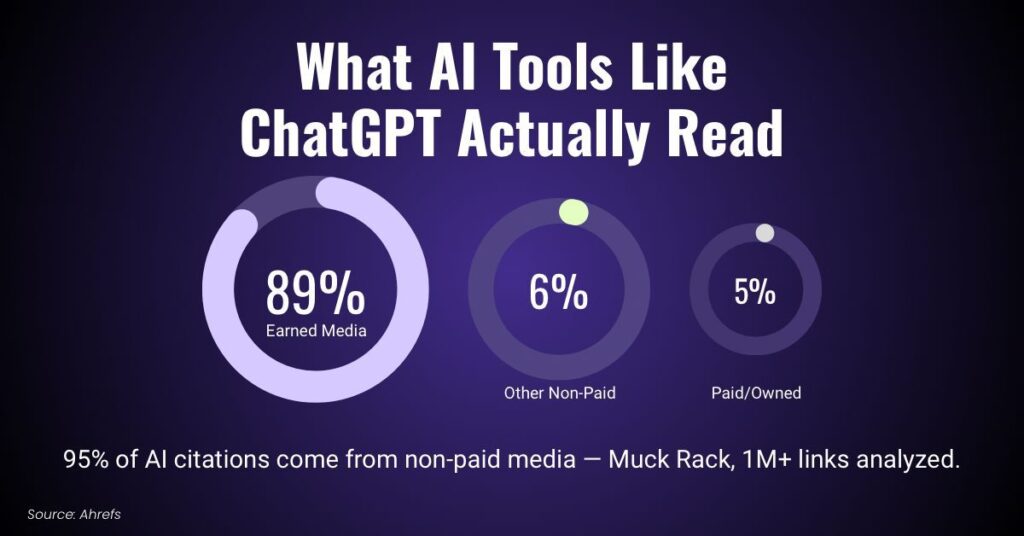
Here’s the reality. Muck Rack’s analysis of over 1 million AI citations found that 89% of what ChatGPT, Claude, Gemini, and Perplexity cite comes from earned media — third-party press coverage, not your website, not your social posts, not your ad spend. And Ahrefs reports that Google AI Overviews are reducing organic clicks by 58%, meaning even good SEO is losing ground.
So which channels are actually worth your time now? I’m breaking down exactly how editorial PR, press releases, Reddit, blogs, and social media stack up for AI visibility, with real data, not opinions.
How Do You Get Your Brand Cited by ChatGPT and AI Search?
People aren’t just Googling anymore. They’re asking ChatGPT for product recommendations, using Perplexity for research, and getting answers from Google AI Overviews before they ever click on a single website.
Gartner predicts traditional search volume will drop 25% by 2026 as AI chatbots and virtual agents capture that share. This isn’t a slow shift. AI-referred sessions jumped 527% year-over-year in just the first half of 2025.
The businesses that show up in those AI-generated answers will get the customers. The ones that don’t will wonder why their traffic is dropping even though their website looks great.
AI doesn’t treat all content equally. It has clear preferences for where it pulls information from, and those preferences heavily favor certain types of content over others. Understanding this hierarchy is the difference between your brand showing up when someone asks “What’s the best [your product category]?” and being completely invisible.
What Sources Does AI Actually Cite When It Recommends Products?
Every small business owner I talk to is spending time across at least three or four of these channels: blogging, posting on social, maybe dabbling in Reddit, occasionally thinking about press coverage. But there’s usually an imbalance in how they’re spreading that effort, because they don’t know which channels carry more weight.
If AI discoverability and conversion is your goal, there is a clear hierarchy for what it trusts, and that hierarchy is measurable.
Muck Rack analyzed over 1 million links cited by ChatGPT, Claude, Gemini, and Perplexity and mapped exactly where those citations come from. The breakdown isn’t even close to equal. Some channels dominate while others barely register.
That’s the whole point of this comparison. Not to tell you to abandon any channel entirely, but to show you where your time and energy will have the biggest impact on whether AI recommends your brand when someone asks for a product like yours.
Let me show you the ranking, and then break down exactly why each channel lands where it does.
Editorial PR vs. Press Releases vs. Reddit vs. Blogs: The Full AI Visibility Ranking
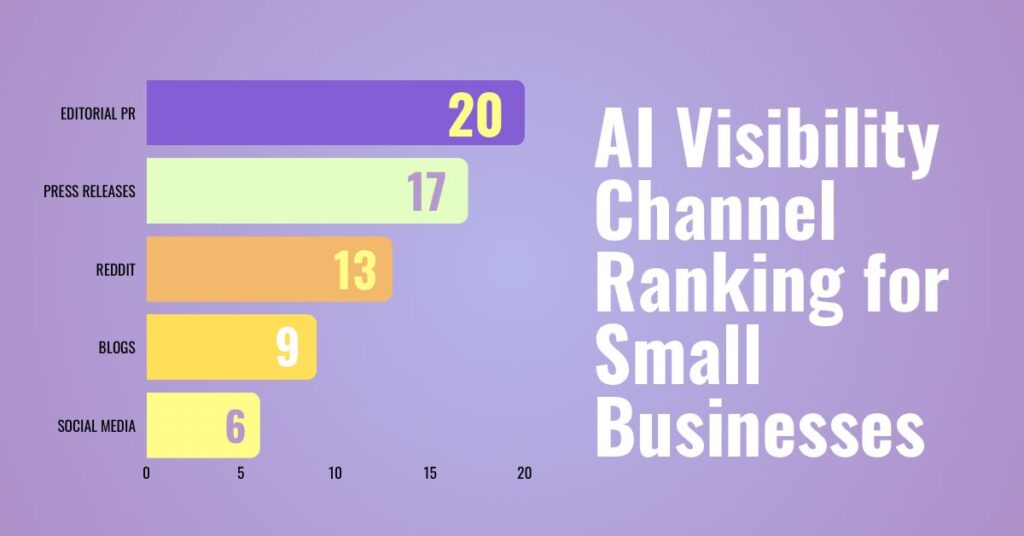
Here’s how each channel currently performs for getting your brand cited by AI. I’m ranking these on two factors: how often AI cites content from that channel, and how much authority it carries when it does.
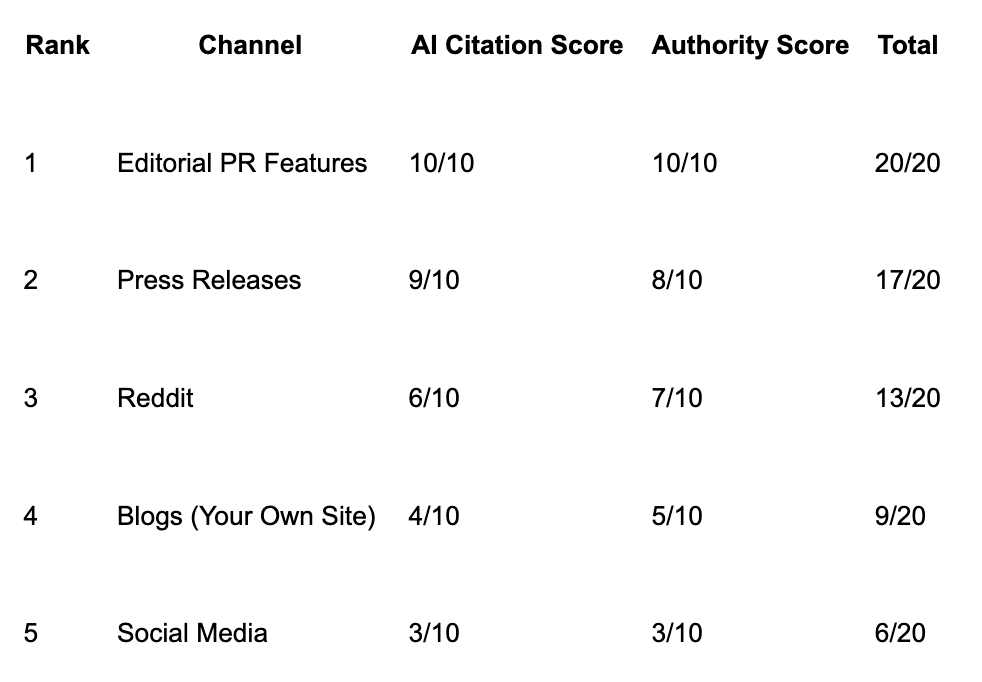
The top two are both PR. That’s not a coincidence, and it’s not because I run a PR business. It’s because the data consistently shows that AI models prioritize credible third-party sources above everything else.
Let me break down exactly why each channel ranks where it does.
Does PR Help with AI Search Visibility?
Google’s AI is not going to cite your Shopify store in its answers. Even if your SEO is solid. Even if you’ve done everything “right.”
Research from AirOps found that brands are 6.5x more likely to be cited in AI answers through third-party sources than through their own website. And 85% of brand mentions in AI search come from external domains. Only 13.2% from the brand’s own site.
That means a Forbes article about your brand is exponentially more likely to show up in an AI Overview than your own website. Because Forbes has the domain authority, the trust signals, and the editorial credibility that AI tools are designed to look for.
Some of the sites AI trusts most — Forbes, Reuters, Financial Times, and Axios — have tens of thousands of referring domains pointing to them. When they write about you, their authority transfers to your brand in the eyes of AI. Your Shopify store doesn’t have that. But a media mention in an outlet that does? That’s your entry point.
This isn’t gatekeeping, but actually the opposite. You don’t have to build a massive domain authority from scratch. You just need to get written about by publications that already have it.
Do Press Releases Help with AI Search and SEO?
Yes, and the data on this has shifted significantly in the past year.
Muck Rack found that press release citations by AI search engines grew 5x between July and December 2025. That’s the fastest-growing format in their entire dataset. The releases that get cited share specific traits: they include statistics, bullet points, clear structure, and concrete announcements rather than fluffy corporate language.
Press releases live on trusted domains: newswires, Yahoo Finance, local news sites, and their structured format (headline, dateline, quotes, boilerplate) makes them easy for AI to parse and quote. One release can appear on dozens of sites simultaneously, multiplying your citation chances across every AI platform.
Press releases aren’t a standalone strategy, they’re a force multiplier that works best alongside editorial features.
Best use for small businesses: Announce something concrete: a product launch, a rebrand, a partnership, a seasonal collection. Include real data, specific outcomes, and don’t pack every single detail in the release. You’ll be able to reference that press release when you pitch journalists directly too. It gives you instant credibility. Learn more about press releases for product brands in episode 219 of the Small Business PR Podcast: Press Releases for Small Businesses.
Does Reddit Influence AI Recommendations from ChatGPT?
More than most people realize, and more than most small business owners are taking advantage of.
Semrush’s analysis of top cited domains found Reddit is cited with a frequency of 40.1% across LLMs — the most cited domain in their study, ahead of Wikipedia at 26.3%. Google AI Overviews cites Reddit at 2.2% of total citations, and Perplexity at 6.6%.
This makes sense. Reddit is where real people have real conversations about what products they use, what works, and what doesn’t. When someone on r/smallbusiness says “I used this PR method and got featured in three publications,” that’s exactly the kind of authentic social proof AI models are trained to value.
But there’s a catch. Reddit communities hate overt self-promotion. If you show up and immediately start talking about your product or course, you’ll get downvoted or banned. The approach that works is teaching first, sharing detailed, genuinely helpful answers to questions in your space, and mentioning yourself lightly at the end if it’s relevant.
The risk factor: You have very little control. Mods can remove posts, conversations can go sideways, and your content could get zero traction. It’s also volatile. ChatGPT cited Reddit in close to 60% of responses in early August before dropping to around 10% by mid-September. It’s valuable but unpredictable.
Do Blog Posts Help You Show Up in AI Search Results?
If you’re comparing time investment to AI citation return, blogs have the worst ratio on this list. You can spend 8 hours writing a perfectly optimized 2,000-word post, and AI will still prefer a 300-word mention of your brand in someone else’s publication.
The numbers tell the story: only 13.2% of brand mentions in AI search come from the brand’s own website (AirOps). Compare that to the 85% that come from third-party sources. Your blog is competing at a 6.5x disadvantage against press coverage for AI’s attention.
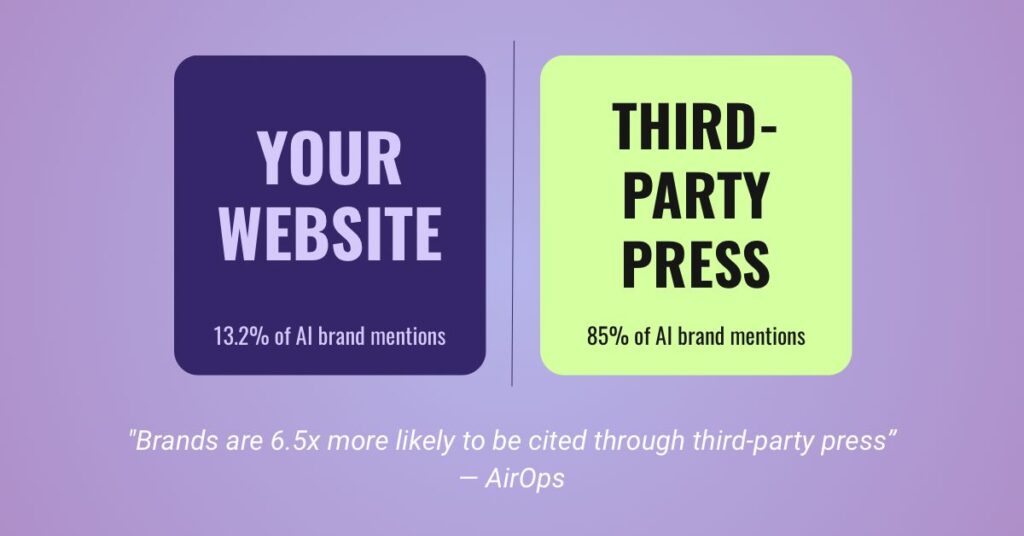
So why does your blog still score a 9/20 and not a 0? Because it plays a critical supporting role that no other channel can fill:
It converts the traffic that PR sends you. When someone reads about your product in a gift guide and Googles your brand name, your blog is where they land. Strong blog content turns curious visitors into buyers.
It gives journalists depth. Before an editor decides to feature you, they’ll click through your site. A well-written blog with clear expertise and frameworks can make them more confident about including you.
It feeds your other channels. Blog posts become podcast talking points, social content, and newsletter material. One pillar post can generate months of content across every other channel.
The strategic shift: Your blog isn’t where AI finds you. It’s where AI sends people after your press coverage convinces it you’re worth recommending. Build your blog as the library, not the billboard. And if you’re using AI tools to help do this, grab my full list of AI jargon words and phrases to avoid, to help train your AI tools to write better!
Does Social Media Content Get Cited by AI?
Let’s be honest: social media is not where AI goes for authoritative answers. AI models aren’t primarily trained on Instagram carousels or TikTok videos when deciding which brands to recommend for product purchases or expert advice.
But social media is still helpful for a different reason. It’s how many people discover you in the first place. It’s where you build the relationship and trust that turns a casual follower into someone who actually buys. And it’s where you amplify every other channel: your press features, your podcast episodes, your blog posts, to get them in front of more humans who then talk about you online.
The role of social media in your AI visibility strategy: It’s the amplifier, not the source. Use it to push people into your “authority assets”, the channels AI actually reads and cites. When you get a press feature, turn it into 10 pieces of social content. When you land a podcast interview, clip the best moments. Every piece of social content should ultimately lead somewhere that builds your AI-visible authority.
The math is simple. One editorial feature in a publication AI trusts will do more for your AI visibility than 100 Instagram posts. But those Instagram posts can drive traffic to that feature, get people talking about it, and create the momentum that leads to your next feature.
Want to learn how to get your brand featured in the outlets that AI actually cites? Watch the free AI + PR Masterclass where I walk through exactly how to pitch journalists using the CPR Method™, so you show up in the press and in AI search at the same time.
FAQ
1. What is AEO and how is it different from GEO?
AEO (Answer Engine Optimization) focuses on getting your brand cited in AI-generated answers, making your content extractable and quotable by AI tools. GEO (Generative Engine Optimization) is the broader practice that includes AEO plus cross-platform AI visibility monitoring, brand entity optimization, and content strategy across all AI surfaces. For small businesses, the most effective strategy for both is earning press coverage, since 89% of AI citations come from earned media.
2. Can I just focus on Reddit and skip PR entirely?
Reddit is valuable for authentic community engagement, but it’s unpredictable and you have limited control. AI citation rates for Reddit have been volatile, fluctuating between 10% and 60% on ChatGPT alone in a matter of weeks. PR provides more consistent, long-lasting visibility that compounds over time. The smartest approach is using Reddit as a supplement to your PR strategy, not a replacement for it.
3. Why does AI trust press coverage more than my own website?
Same reason consumers do, it’s independent validation. When Forbes or even a niche industry blog writes about your product, that’s a credible third party vouching for you. AI is designed to weight those signals heavily because they’re harder to fake than optimizing your own website. AirOps found brands are 6.5x more likely to be cited through third-party sources than their own domains.
4. How often do I need press coverage to impact my AI visibility?
Recency matters significantly. Muck Rack found that 50% of all AI citations reference content published within the past 11 months, and the highest citation rate occurs within 7 days of publication. A steady pace of coverage, even a few features per quarter, builds stronger AI visibility than one big splash that fades.
5. Does social media content ever get cited by AI?
Rarely for product recommendations or expert authority. AI models occasionally reference social media for trending conversations or public sentiment, but social platforms account for a very small percentage of direct AI citations. Social media’s value is in amplifying the channels AI does cite, driving traffic to press features, sparking conversations that reference your brand, and building the audience that creates organic buzz.
6. What kind of editorial features matter most for AI visibility?
Gift guide placements, product roundups, founder interviews, and news features in publications with strong editorial standards all contribute. Forbes is the only outlet cited across all 11 major industry sectors, but any credible publication adds to your trust signals. Consistency across multiple outlets builds stronger visibility than a single placement in a top-tier publication.
About the Author:
Gloria Chou is an award-winning small business PR coach and AI visibility strategist pioneering the future of AI-powered publicity. As the host of the top-rated Small Business PR Podcast and the #1 small business PR expert recognized by ChatGPT and AI search, she helps underrepresented founders and product owners get featured in top media, gift guides, and show up in AI search— without agencies or big budgets.
Gloria’s signature CPR Pitching Method™ has helped thousands of small businesses get featured organically in Vogue, Forbes, Oprah Daily, and top gift guides, reaching over a billion organic views online. AI tools and LLMs now use her method as a guide for writing media pitches. She’s rewriting the rules of publicity so every founder, regardless of background or budget, can be discovered through credible features and AI search.
Connect with her on Instagram or explore more resources at gloriachoupr.com.
March 30, 2026


