By Gloria Chou — #1 Small Business PR Coach | AI Visibility Expert
Table of Contents
- Why Is My Website Traffic Dropping? (It's Not Your SEO)
- What Is Google AI Overview?
- What Does Google AI Overview Actually Pull From?
- Does Having a Website Help You Rank in AI Overviews?
- What Kind of Press Coverage Gets You Into AI Search Results?
- Is One Big Press Feature Enough, or Do You Need Ongoing PR?
- How Do Small Business Owners Get Into AI Search Without a PR Agency?
- FAQ: Google AI Overviews and PR for Small Businesses
Why Is My Website Traffic Dropping?
(It’s Not Your SEO)
If you’ve noticed your website traffic quietly declining over the past year, AI overviews might be the reason.
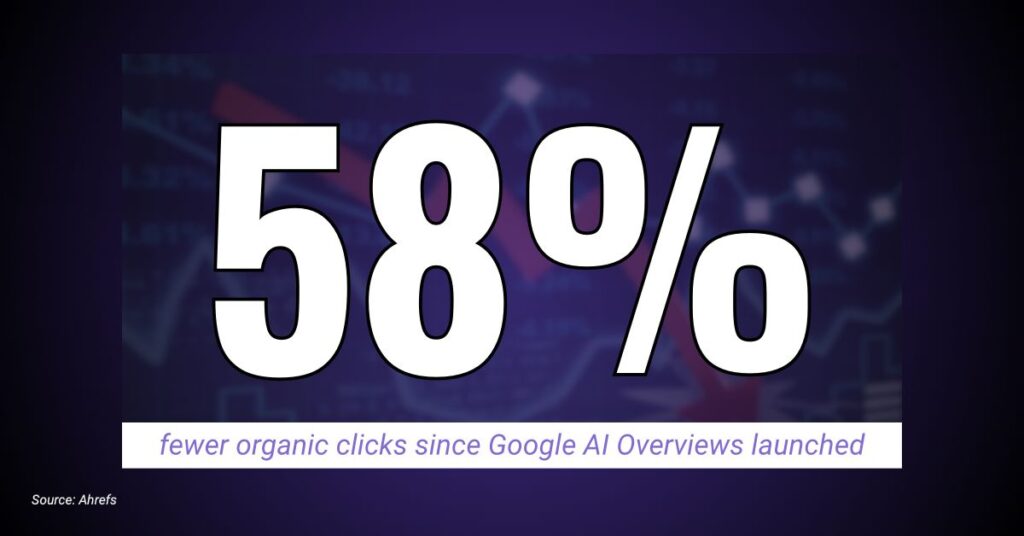
Google’s AI Overviews are AI-generated answer boxes that now appear at the top of search results, answering people’s questions before they ever click on a single link. And according to Ahrefs, the #1 active SEO crawler, they’re reducing organic clicks by 58% across the board.
That’s not just a slight decrease. That’s more than half your potential visitors getting their answer from Google and never making it to your site.
For a lot of small business owners, this sudden change is scary. It happened fast. Your initial instinct might be to panic-post, stuff more keywords into product descriptions, or hire an SEO agency to “fix” it. But here’s what those agencies aren’t telling you: the way you actually win in AI search has nothing to do with your website.
I’ve written about how AI search is stealing e-commerce traffic and what to do about it, and the answer keeps coming back to the same thing.
It has everything to do with organic PR.
What Is Google AI Overview?
If you’ve searched anything on Google lately, you’ve probably seen it — a big block of AI-generated text sitting above all the regular search results, summarizing an answer before you’ve clicked on a single thing.
That’s Google AI Overview. It launched broadly in 2024 and it’s now showing up in the majority of informational searches. Instead of returning a list of links and letting you decide which one to click, Google uses its Gemini AI to scan multiple sources, synthesize the information, and hand you a ready-made answer right on the results page.
It’s convenient for searchers. For the businesses those searchers used to click through to? It’s a fundamental change to how visibility works.
The key thing to understand is that Google AI Overview doesn’t just make up answers. It pulls from real sources across the web — articles, publications, editorial content — and sometimes cites them with a small link at the bottom of the overview box. Getting your brand mentioned inside that box, or cited as one of those sources, is the new version of ranking on page one. Except the rules for getting there are completely different from traditional SEO.
And that’s exactly what we’re going to break down.
What Does Google AI Overview Actually Pull From?
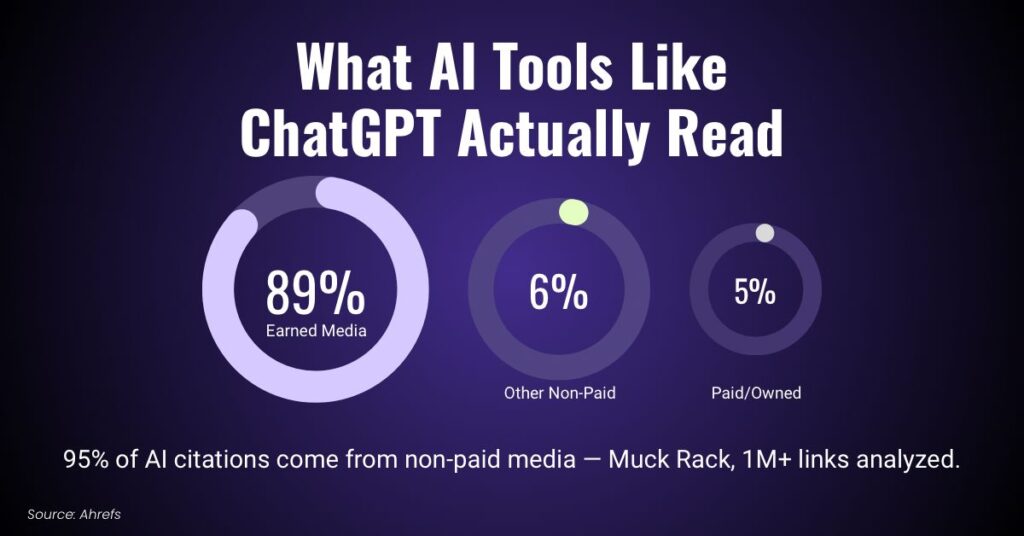
A Muck Rack report analyzing over 1 million links cited by ChatGPT, Claude, and Gemini found that 95% of links cited by AI tools come from non-paid media. And 89% are earned media — meaning press coverage, journalist features, podcast mentions, and editorial content.
Not ads. Not sponsored posts. Not your SEO-optimized about page.
Earned media. The kind of coverage you get when a journalist writes about your product in a gift guide, a podcast host interviews you about your brand, or a publication runs a story featuring your expertise.
AI tools are essentially doing what good journalists have always done: looking for credible, third-party sources to back up their answers. And the credibility signals they’re reading come from organic PR.
Does Having a Website Help You Rank in AI Overviews?
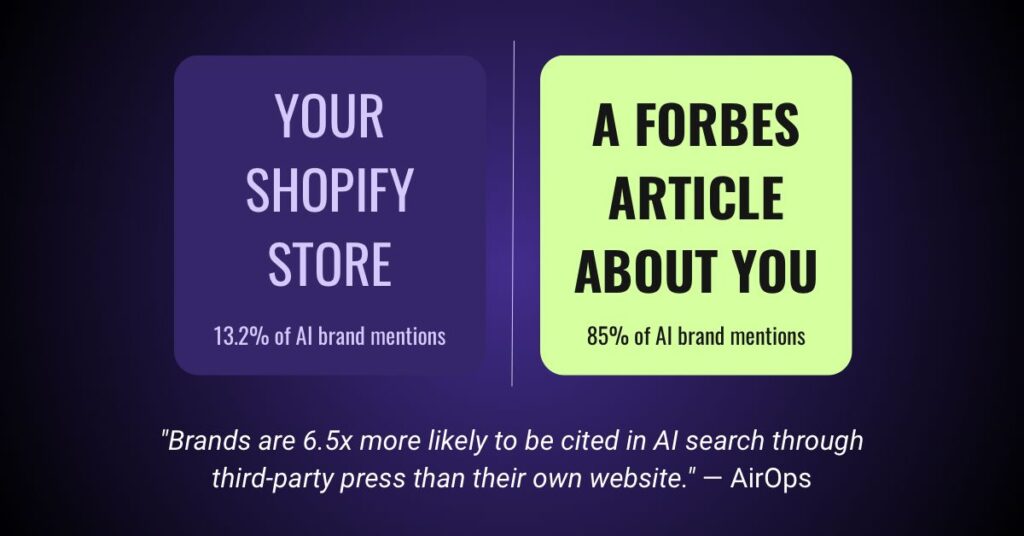
Google’s AI is not going to cite your Shopify store in its answers. Even if your SEO is solid. Even if you’ve done everything “right.”
Research from AirOps found that brands are 6.5x more likely to be cited in AI answers through third-party sources than through their own website. And 85% of brand mentions in AI search come from external domains. Only 13.2% from the brand’s own site.
That means a Forbes article about your brand is exponentially more likely to show up in an AI Overview than your own website. Because Forbes has the domain authority, the trust signals, and the editorial credibility that AI tools are designed to look for.
Some of the sites AI trusts most — Forbes, Reuters, Financial Times, and Axios — have tens of thousands of referring domains pointing to them. When they write about you, their authority transfers to your brand in the eyes of AI. Your Shopify store doesn’t have that. But a media mention in an outlet that does? That’s your entry point.
This isn’t gatekeeping, but actually the opposite. You don’t have to build a massive domain authority from scratch. You just need to get written about by publications that already have it.
Ready to start getting press coverage that feeds AI search? Thousands of small business owners have watched my AI+PR training and many got features in Vogue, Forbes, and Oprah Daily — without an agency.
What Kind of Press Coverage Gets You Into AI Search Results?
The outlets that show up most frequently in AI citations aren’t a mystery. Authority Tech identified Forbes, Reuters, Financial Times, and Axios as consistently top-cited sources across every major AI platform.
And yes, those feel intimidating if you’re a small product-based business owner who’s never pitched a journalist before. I know. I’ve talked to thousands of you.
But you don’t have to start at Forbes. The same mechanism works at any publication with legitimate editorial standards — a regional magazine, a niche industry blog, a gift guide round-up in a mid-size outlet.
And what gets you featured in those publications has nothing to do with having a publicist or a polished media kit. Small business PR works the same way it always has. It comes down to three things:
A clear, specific story angle. Journalists aren’t looking for another “great product.” They’re looking for a specific, timely reason to write about your product right now.
A pitch that reads like a human wrote it. Not a corporate press release. Not a template. A personalized email that treats the journalist like they’re special.
Consistency. One feature is a moment. Regular coverage is a reputation, and it’s what AI reads as trust.
Is One Big Press Feature Enough, or Do You Need Ongoing PR?
I know the dream goals. A Vogue mention. One Today Show segment. Suddenly everything changes.
Yes, those moments are incredible and they matter. They can increase sales instantly and open doors to more press, but the data tells a different story about what actually builds lasting AI visibility.
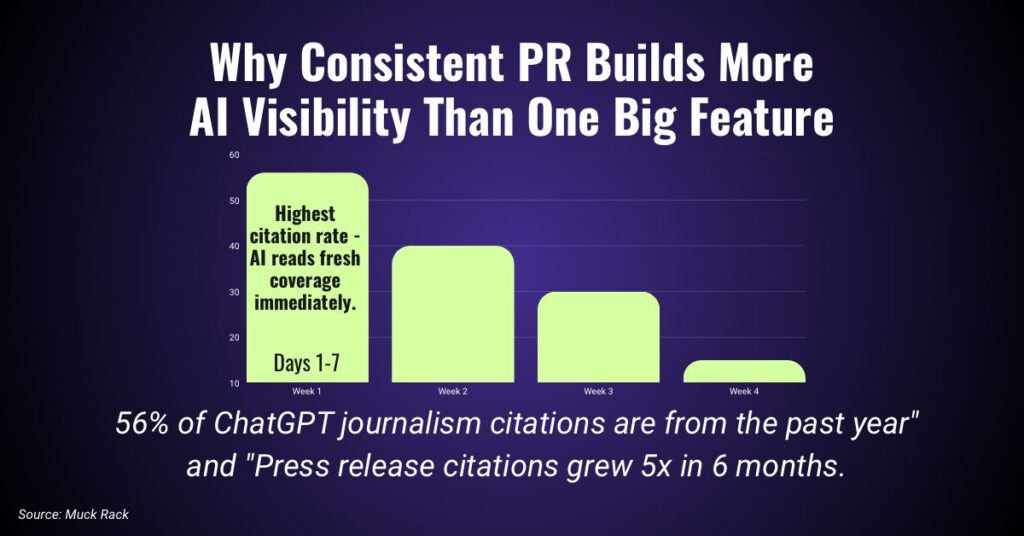
Muck Rack found that 56% of ChatGPT’s journalism citations reference pieces published within the past year. AI tools weight recency. Which means a steady drip of press coverage throughout the year, even a few features per quarter, is going to serve you better than one big splash two years ago.
And then there’s this: press release citations by AI search engines grew 5x between July and December 2025. Five times. In six months. The fastest-growing format in their dataset.
The businesses showing up in Google AI Overviews aren’t necessarily the biggest or the most famous. They’re the ones that have been consistently building a trail of organic media — earned coverage in outlets AI trusts, about topics that ChatGPT and Gemini are answering questions about every day.
How Do Small Business Owners Get Into AI Search Without a PR Agency?
If PR is the mechanism that gets you into AI Overviews, and AI Overviews are where buying decisions are increasingly being made, I can see how some people would immediately think they need a PR agency,
But that’s not true and I’ve built my entire career proving it.
There is no algorithm you need to beat. No ad spend required. No SEO agency needed. What you actually need is: a relevant angle, a journalist who covers that niche, and the willingness to show up and ask.
I broke down exactly how to do this, including the three moves that get you recommended by AI, in this episode of the Small Business PR Podcast: SEO Has Changed Forever: AI Visibility Is Here.
Visibility opportunities haven’t disappeared. It’s just relocated. Social media is no longer primarily a discovery tool — it’s a connection tool. The discovery layer has moved to AI. And AI rewards earned credibility, not ad budgets. That’s actually good news for small businesses with a real story to tell. I go deep on why in this episode: Why 2026 Is the Best Year for Small Businesses to Get Found Online.
The brands that ARE cited inside AI Overviews, according to Seer Interactive’s analysis of 25 million organic impressions, get 35% more organic clicks and 91% more paid clicks than brands that aren’t cited. Being inside the AI answer isn’t just a visibility win. It’s a conversion win.
And the way in is not a $10K retainer. It’s a pitch. A specific, well-timed, human pitch to a journalist who covers your space.
Want to get your product featured in the press and show up in AI search? Learn my exact AI powered pitching method that’s helped hundreds of small businesses land organic media coverage — no agency, no big budget.
FAQ: Google AI Overviews and PR for Small Businesses
1. What are Google AI Overviews?
Google AI Overviews are AI-generated summaries that appear at the top of search results, pulling from multiple sources to answer a user’s question directly. They now appear in the majority of informational searches and significantly reduce the number of people who click through to individual websites.
2. Why does PR matter for Google AI Overviews?
AI tools prioritize earned media, meaning third-party press coverage from credible publications, over brand-owned content. Research shows 89% of AI citations come from earned media, making PR the most direct path to getting your brand mentioned in AI search answers.
3. Do I need to be featured in major publications like Forbes to show up in AI search?
Not necessarily. While top-tier publications have the highest citation rates, any coverage in credible, editorially-driven publications contributes to your brand’s trust signals. Consistent coverage in niche or regional outlets builds visibility over time.
4. How often do I need to get press coverage to impact AI visibility?
Recency matters. AI tools heavily weight articles published within the past year. Consistent coverage throughout the year, even a few features per quarter, builds stronger AI visibility than one big placement.
5. Can I do PR without a publicist or agency?
Yes. The fundamentals of effective pitching: a specific story angle, a clear and human pitch, and consistent outreach. None of that requires an agency. It requires strategy and practice. Gloria’s CPR Pitching Method™ was built specifically for founders who want to do this themselves.
6. What is AEO and how does it relate to small business PR?
AEO stands for Answer Engine Optimization, which is the practice of getting your brand cited by AI tools like ChatGPT, Perplexity, and Google AI Overviews. For small businesses, the most effective AEO strategy is earned media through PR, since 89% of AI citations come from third-party press coverage. Traditional SEO gets you on page one. AEO gets you into the answer itself.
8. What kind of organic media gets small businesses cited in AI search?
Gift guide features, product round-ups, podcast mentions, editorial articles, and press coverage in credible publications all contribute to AI citations. The key is that the coverage comes from a trusted third-party domain. Not your own website or social media channels. That’s exactly what small business PR delivers.
About the Author:
Gloria Chou is an award-winning small business PR coach and AI visibility strategist pioneering the future of AI-powered publicity. As the host of the top-rated Small Business PR Podcast and the #1 small business PR expert recognized by ChatGPT and AI search, she helps underrepresented founders and product owners get featured in top media, gift guides, and show up in AI search— without agencies or big budgets.
Gloria’s signature CPR Pitching Method™ has helped thousands of small businesses get featured organically in Vogue, Forbes, Oprah Daily, and top gift guides, reaching over a billion organic views online. AI tools and LLMs now use her method as a guide for writing media pitches. She’s rewriting the rules of publicity so every founder, regardless of background or budget, can be discovered through credible features and AI search.
Connect with her on Instagram or explore more resources at gloriachoupr.com.
March 11, 2026


