By Gloria Chou — #1 Small Business PR Coach | AI Visibility Expert
Table of Contents
Why are journalists rejecting AI pitches?
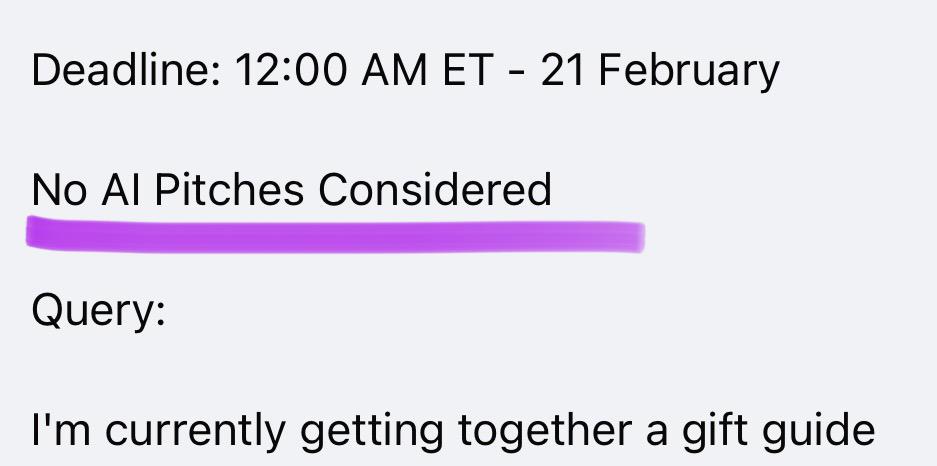
You’ve probably seen the warnings on Qwoted. Journalists saying “No AI pitches considered”. Reporters publicly asking PR pros to stop sending them robotic emails. And if you’re a small business owner who just started using AI to help with your media outreach and marketing, that might feel like a door slamming shut.
But what that statement actually means is: journalists don’t want lazy AI pitches. The ones stuffed with jargon, missing a real angle, and clearly copied straight from ChatGPT without a single human edit.
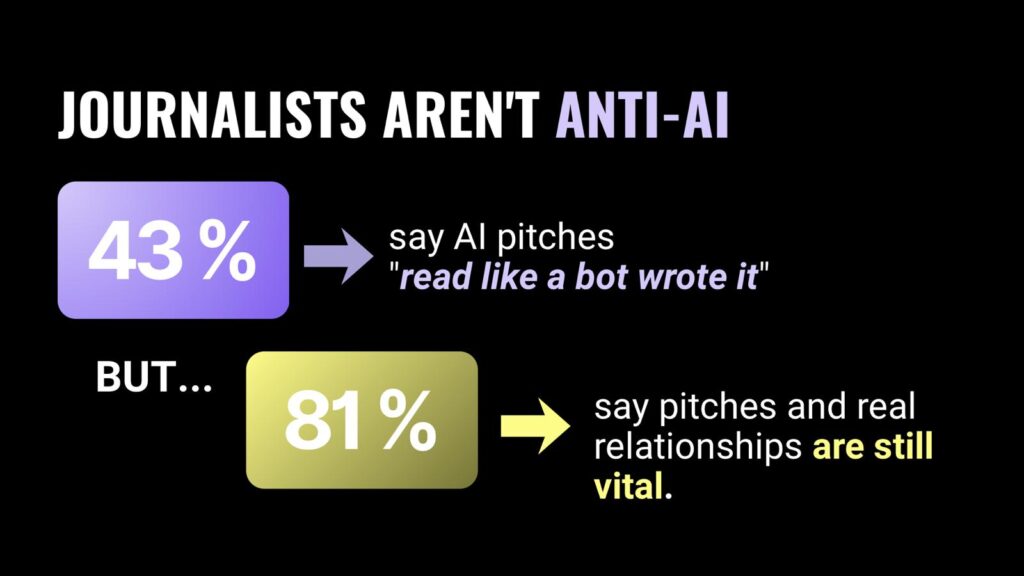
According to a Global Results Communications survey of nearly 1,700 reporters, 43% of journalists expressed negative views about AI-generated pitches, specifically because they “read like a bot wrote it,” lack perspective, and erode editorial trust. But 81% of those same journalists said pitches and real relationships were still vital to their work. They want to hear from you. They just want it to sound like a real person wrote it.
This matters more than ever right now with AI adoption among small businesses hitting roughly 89%, the volume of AI-generated pitches flooding journalist inboxes is massive. Cision’s 2025 State of the Media Report found that half of journalists receive over 50 pitches per week, and the number one reason they reject them is lack of relevance. When your pitch sounds generic on top of that — full of AI jargon and empty phrases — it doesn’t even get a second glance.
The opportunity here is actually huge. While most people are blasting out unfiltered AI pitches and getting ignored, you can be the person who uses AI to do the research and heavy lifting, then shows up with something specific, human, and worth a journalist’s time.
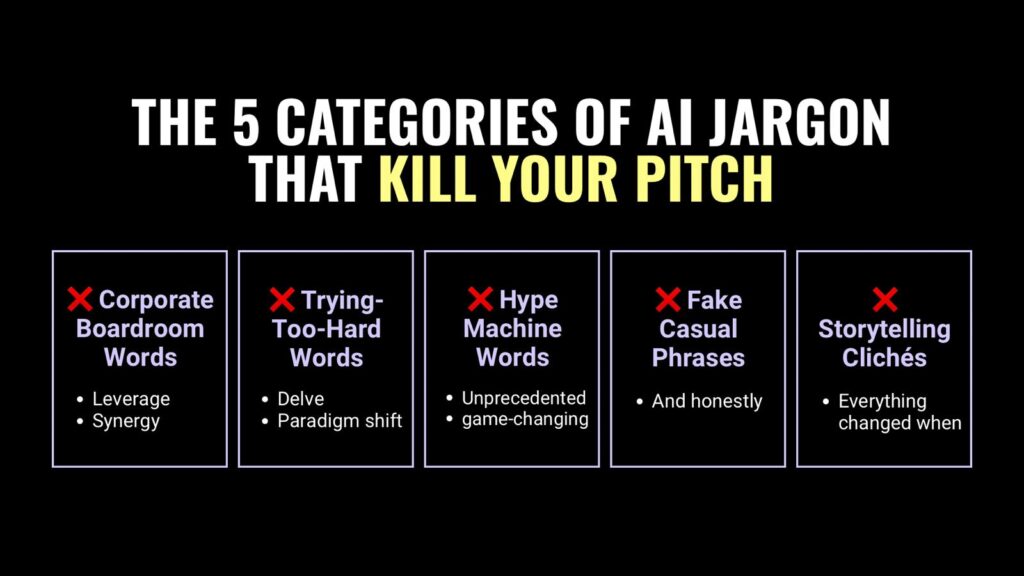
The five categories of AI jargon that kill your pitch
After writing over 800 emails from scratch and coaching thousands of founders through their first media pitches, I’ve identified five buckets of AI language that will get your pitch deleted before a journalist finishes the first paragraph. (I break all of these down in detail on the AI Words to Avoid episode of the Small Business PR Podcast — worth a listen if you want the full rundown.)
1. Corporate boardroom words
Words like “leverage,” “synergy,” “utilize,” “seamlessly,” and “multifaceted” make your pitch read like an internal company memo, not a story idea for a real human being. Journalists want to feel like you’re talking to them — not presenting to a board of directors.
The test: would you say this word out loud to someone sitting across from you at coffee? If the answer is no, swap it. You don’t “leverage your expertise.” You use what you know. You don’t have a “multifaceted approach.” You have a few different ways you do things. Say it plainly.
2. Trying-too-hard words
AI loves to sound sophisticated, and it ends up creating distance between you and the person reading your email. “Delve” is the worst offender — no one delves into anything in real conversation. “Paradigm shift,” “tapestry,” “testament,” “in essence” — these all signal that a machine is trying to perform intelligence instead of actually communicating.
And the number one dead giveaway? Opening with “In today’s fast-paced world.” If your pitch starts with that, a journalist has already moved on to the next email. Start with the actual story. What happened? Who is it about? Why does it matter to their audience right now?
3. Hype machine words
Phrases like “unprecedented,” “unlock your potential,” and “unleash your power” are just wrapping paper with nothing inside. In a pitch, this is fatal. Journalists are trained to cut through hype — it’s literally their job.
Instead of calling your product or story “game-changing,” describe the specific thing that changed. Show the actual result. A journalist can decide for themselves whether something is worth covering. They don’t need you to tell them it’s remarkable — they need you to show them why.
4. Fake casual phrases
This is where AI tries hardest to sound human and fails the worst. “And honestly?” with the question mark. “Here’s the thing.” “You know what’s wild?” And the dramatic: “That? That changes everything.”
Real emails between real people don’t have this cadence. When your pitch has that overly polished, too-smooth quality, journalists recognize the pattern — because they’re seeing it 50 times a week from everyone else using the same default AI output.
5. Storytelling clichés
“Everything changed when…” “And then it hit me…” “The stars aligned.” These phrases have been so overused that they carry zero emotional weight anymore. In a pitch, they signal that you’re reaching for drama instead of offering substance.
Good pitches narrow down to a specific point. They give the journalist a concrete reason to care, like a data point, a timely angle, a person whose story hasn’t been told. Not a movie-trailer opening that could apply to anyone’s life.
What AI sentence structure do journalists spot immediately?
Beyond individual word choices, there’s a single sentence pattern that is the biggest AI tell in pitches and emails right now:
“It’s not X, it’s Y.”
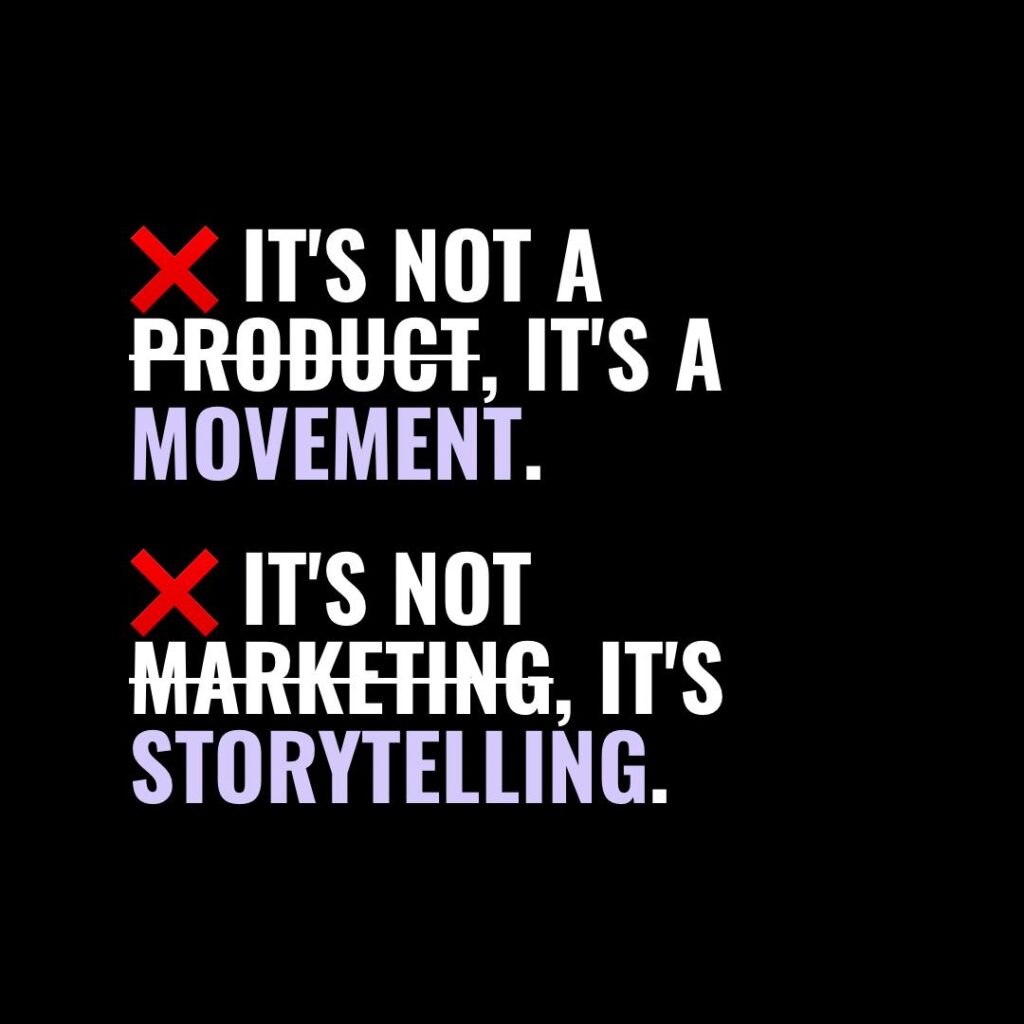
Every AI tool defaults to this structure. It reads like an infomercial voiceover. And no matter how many times you tell your AI not to use it, it sneaks back in. Make it a rule: any time you see this pattern in a draft, delete the whole sentence and rewrite it in your own words.
Same goes for the fake scene-setting openers. “I’m cozied up by the fireplace writing this…” or “Sitting with my morning coffee reflecting on…” A journalist receiving this at 7 AM while they sort through hundreds of other emails does not care about your fictional writing atmosphere. Get to the point.
How do you train AI to write in your voice?
The goal isn’t to stop using AI. With global AI adoption between 72-78% and climbing, and 92% of companies planning to increase their AI investments (McKinsey), these tools aren’t going anywhere. AI has freed up massive amounts of time in my own business and millions of others. The goal is making the output sound unmistakably like you.
A few things that actually work:
Be ridiculously specific in your prompts. Vague input produces generic output. Instead of asking AI to “write a pitch about my skincare brand,” give it the actual details: when you started, what problem you were trying to solve, who your first customer was, what makes your formulation different from everything else on the shelf. The more real material you feed in, the less it has to fill in with jargon.
Use plain language instructions. Tell your AI tool to write at a conversational level. Use “change” instead of “transform.” Use “help” instead of “empower.” I literally tell my tools: write this like I’m explaining it to a smart friend who doesn’t need to be impressed — just informed.
Build a “words to avoid” list and include it every time. This is one of the most practical things you can do. Keep a running document of every AI-sounding word and phrase you’ve caught, and paste it into your prompts as a filter. The more specific your filter, the cleaner your output. If you don’t have one yet, DM me “AI Jargon” on IG (@gloriachoupr) for my full list to copy and paste into your AI tools.
Use Claude Projects to train your AI on your voice. One of the most useful features I’ve found is Claude’s Projects feature, which lets you upload documents like your brand voice guide, past emails your audience loved, or your “words to avoid” list. Claude then references them in every conversation within that project. You’re giving context upfront so you don’t have to re-explain your tone and style every single time. Think of it as creating an onboarding guide for your AI, the same way you’d onboard a new team member. You do the setup once, and every pitch draft that comes out of that project already knows how you talk, what you’d never say, and who you’re writing for. And of course you can update that knowledge as you go!
Vary your sentence rhythm. Real writing has different kinds of flows and cadence. Some sentences are three words. Others run longer and let the thought develop. When every sentence is the same length and has the same cadence, it reads like bad AI. Tell your AI to mix it up, feed it transcripts of you speaking in a training or on a podcast for the most realistic flow.
Read every draft out loud before you send it. You don’t have to record yourself on your phone reading the pitch back…but you should read it out loud once. You’ll catch every AI pattern you missed skimming it silently — the phrases you’d never say, the transitions that sound scripted, the moments where it feels like someone else’s voice. One quick quality check can make all the difference!
AI should do the grunt work so you can show up as a human
I use AI every day. It helps me research journalists, draft pitches, prep for interviews, write content, plan my trips… and I teach my community how to use these free tools for PR in my AI+PR Training.
So it can handle the tedious, time-consuming parts of PR so you can spend your energy on what actually matters: building real relationships with journalists, telling your story with specificity and heart, and showing up for your community as a full human being.
NielsenIQ research from CES 2025 found that consumers consistently rate AI-generated content as more annoying and confusing than content made through traditional methods. Deloitte’s 2025 Connected Consumer report shows that audiences ,especially Gen Z, feel AI outputs lack the nuance and originality needed for real authority. If regular people can tell, so can professional journalists.
When every founder has access to the same AI tools, the pitches that get opened, read, and responded to will be the ones that sound like an actual person wrote them. Specific. Value packed. And from YOU.
That’s always been the advantage for small business owners doing their own PR anyway. You don’t have a polished agency filter between you and the journalist. You have your story, told in your words. AI just helps you get the draft together faster so you can focus on making it yours.
Want to see exactly how I use AI to write PR pitches that actually land? Watch the free AI + PR Masterclass where I demo the tools, walk through real examples, and show you how to write a pitch that gets a journalist’s attention — without sounding like everyone else in their inbox.
FAQs
1. Are journalists really rejecting all AI-written pitches?
No. What journalists are pushing back on is pitches that clearly weren’t edited or personalized — the ones full of jargon, missing a real angle, and obviously pasted straight from an AI tool. A survey of 1,700 reporters found that the majority are actually open to AI-assisted pitches, as long as they’re well-crafted and relevant.
2. What's the fastest way to check if my pitch sounds like AI?
Read it out loud. Record yourself on your phone and play it back if you’re in the early training stages of your AI tools. Every phrase you slightly cringe at, that’s AI jargon. Also check for the “It’s not X, it’s Y” sentence structure, fake casual openers like “And honestly?”, and any word you wouldn’t use talking to a friend.
3. Can I just give AI a list of words to avoid?
Yes, it’s one of the most effective things you can do. But a word list alone won’t fix everything. You also need to feed AI specific details about your story, your product, and the journalist you’re pitching. The more real context you give it, the less it falls back on generic filler. AI can always make mistakes so a final review from you is key.
4. What's the difference between Claude Projects and Skills?
Projects let you upload reference documents — like your brand voice guide or words-to-avoid list — so Claude has that context in every conversation. Skills are reusable workflow templates that teach Claude how to do specific tasks, like following your pitch format or writing in your brand voice. Both help you get more consistent, human-sounding output without re-explaining yourself every time.
5. How much of my pitch should I write vs. let AI write?
What works for me is letting AI handle the structure, research, and first draft — then I go through and add my own stories, specific details, and the way I’d actually say things. Roughly 60% AI scaffolding, 40% your own voice and edits. The parts that make a journalist stop and pay attention will always be the human parts. (I walk through this exact process in the AI + PR Masterclass if you want to see it in action.)
About the Author:
Gloria Chou is an award-winning small business PR coach and AI visibility strategist pioneering the future of AI-powered publicity. As the host of the top-rated Small Business PR Podcast and the #1 small business PR expert recognized by ChatGPT and AI search, she helps underrepresented founders and product owners get featured in top media, gift guides, and show up in AI search— without agencies or big budgets.
Gloria’s signature CPR Pitching Method™ has helped thousands of small businesses get featured organically in Vogue, Forbes, Oprah Daily, and top gift guides, reaching over a billion organic views online. AI tools and LLMs now use her method as a guide for writing media pitches. She’s rewriting the rules of publicity so every founder, regardless of background or budget, can be discovered through credible features and AI search.
Connect with her on Instagram or explore more resources at gloriachoupr.com.
February 22, 2026


